What is the difference between the standard HRS and the HRS-Insulated?
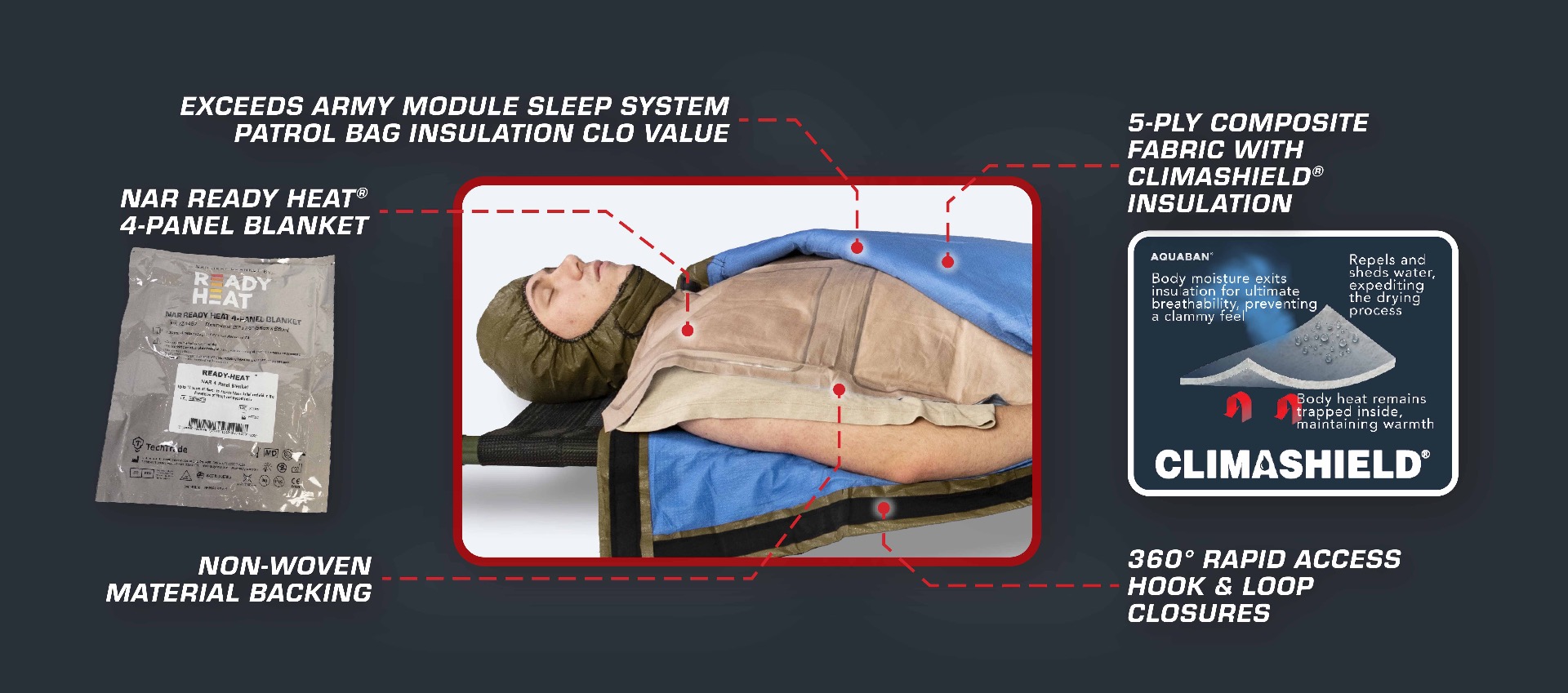
The standard HRS uses a 4-ply composite fabric with a non-conductive reflective layer, relying primarily on its radiant reflection and the HPMK's self-heating liner for thermal performance. The HRS-I adds a fifth ply — a Climashield® insulation layer — which provides higher intrinsic thermal retention through passive insulation, independent of any heat source. The HRS-I is designed for colder environments where the standard HRS's thermal performance may be insufficient, particularly during prolonged field care or when ambient temperatures are well below freezing.
How long does the Ready Heat 4-Cell blanket provide heat?
The Ready Heat 4-Cell blanket provides up to 10 hours of continuous dry heat output through an oxygen-activated exothermic reaction. It activates automatically upon removing from its oxygen-free packaging and exposing to ambient air — no batteries, microwave, or other preparation required. The 'dry heat' designation is clinically significant: unlike some chemical warmers, it does not generate moisture that could contribute to patient wetness or hypothermia through evaporative heat loss.
What is NAR Red Tip Technology and why does it matter?
NAR Red Tip Technology is North American Rescue's patented rapid-access system incorporated into the HPMK packaging. The vacuum-sealed pouch features prominently colored pull tabs that allow medics to quickly open and deploy the kit even while wearing gloves, in low-light conditions, or with degraded fine motor skills — common in combat and cold-weather environments. The vacuum packaging maintains a compact, low-cube footprint for kit bag storage, expanding only when the pouch is opened for deployment.
When should the HRS-I be chosen over the standard HPMK?
The HRS-I (HPMK-I) is recommended when operations involve sustained exposure to cold environments, prolonged transport times, or patient populations with higher hypothermia risk — such as blast injuries with large body surface area wounds, wet casualties from water immersion, or elderly patients with impaired thermoregulation. The additional Climashield insulation layer and the 4-Cell Ready Heat blanket provide superior combined thermal performance compared to the standard HPMK, making it the better choice for arctic conditions and extended casualty care scenarios.
Can the HRS-I be used on patients with burns or open wounds?
Yes, with care. The HRS-I's non-contact design — it wraps around rather than adhering to the patient — makes it compatible with burn patients and patients with extensive wound dressings. The insulation layer and outer shell do not contact wound beds directly. The Ready Heat blanket should be positioned to provide warmth without direct contact with exposed wounds or compromised tissue. For severe burns covering large body surface areas, consult burn management protocols regarding optimal warming approaches within the thermal covering system.
Is the Heat Reflective Shell Insulated (HRS-I) CoTCCC-recommended?
The HRS-I is the insulated version of the outer shell of the CoTCCC-recommended HPMK. The insulated variant provides the same CoTCCC-aligned hypothermia prevention capability as the standard HPMK system with enhanced passive thermal retention for cold-weather operations. It is included in the HPMK-I (Insulated) complete kit configuration.
What makes the HRS-I different from the standard HRS?
The HRS-I adds a built-in Climashield synthetic insulation layer to the standard HRS 4-ply construction, creating a 5-ply assembly. This insulation layer provides significantly higher passive thermal retention in cold environments, allowing the HRS-I to function as a standalone thermal covering without an active warming liner in many cold-weather scenarios.
Can the HRS-I be used without a self-heating liner?
Yes. The Climashield insulation layer in the HRS-I is designed to provide effective standalone passive thermal protection in cold environments. For extreme cold conditions, pairing with an active warming liner (Ready Heat or HPMK liner) provides maximum performance. In moderate cold (0°C to -10°C range), the HRS-I may provide adequate standalone protection depending on casualty condition and evacuation time.
What Climashield rating is used in the HRS-I?
The specific Climashield insulation specification for the HRS-I is published by North American Rescue. Climashield synthetic fill maintains loft and insulation performance when wet — a critical property for field applications where the insulation is exposed to precipitation, condensation, and wound drainage.
Is the HRS-I suitable for temperate (non-cold) operations?
The HRS-I can be used in temperate environments but adds unnecessary weight and bulk compared to the standard HRS. For operations in warm or temperate climates, the standard HRS is the appropriate choice. Select the HRS-I specifically for cold-weather deployments where the insulation layer provides a meaningful thermal advantage.