


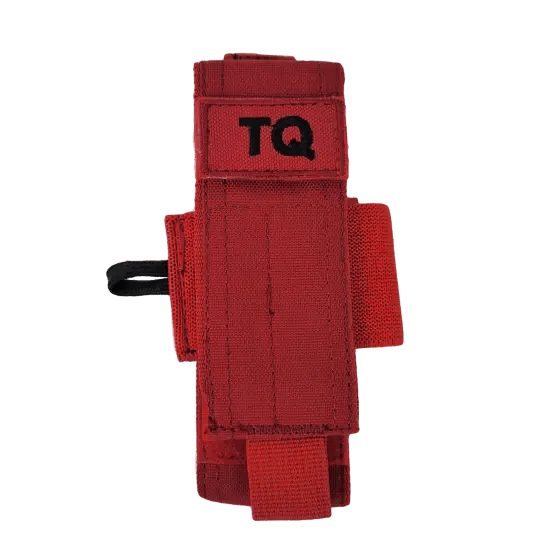


A tourniquet nobody can find is a tourniquet nobody applies. Put it where either hand reaches it without looking, and mark the spot.
At a glance
10 things to know about the Universal Tourniquet Holder
What the holder is, what it takes, how it holds, and what to settle before you rely on it.
-
01
Who makes it
Elite First Aid, Inc. of Shelton, Connecticut makes the Universal Tourniquet Holder and markets it as US made. The empty holder is part number 630 in Black (630B), Olive Drab (630OD), Tan (630T) and Red (630R).3
-
02
A carrier is not a tourniquet
The Evidence-Based Standard Devices & Adjuncts list names tourniquets — among them the C-A-T Gen 7 (NSN 6515-01-521-7976) and the SOF-Tactical Tourniquet-Wide (NSN 6515-01-587-9943) — and no holders.2 The holder has no status of its own; the tourniquet inside it keeps its own.
-
03
Built to take the major tourniquets
Elite First Aid designed the holder to hold any major tourniquet on the market, including the C-A-T, the SOF-T and the SWAT-T.3 The C-A-T Gen 7 and the SOF-Tactical Tourniquet-Wide are on the evidence-based list; the SWAT-T is an elastic wrap that is not on it.2 Absence from the list does not by itself mean a product was tested and failed.
-
04
Elastic hook-and-loop strap
One main elastic hook-and-loop strap secures the tourniquet in the holder.3 Test the exact tourniquet you carry: seat it, close the strap, and confirm it stays put through movement and comes out in one pull.
-
05
Snag-resistant nylon top strap
A nylon top strap keeps the tourniquet from getting caught during your daily routine.3 Draw it a few dozen times, gloved, to confirm it clears the strap cleanly.
-
06
MOLLE compatible
Elite First Aid makes the holder MOLLE compatible, so it attaches to any MOLLE-attachable pack.3 Vests, chest rigs, plate carriers and MOLLE panels use the same webbing.
-
07
A patch that marks the spot
A 1 × 2 in. "TQ" patch is removable; swap it for any small standard patch, including a blood-type patch.3 A marked position is easier to find under stress, and easier for a bystander to spot when you cannot reach it.
-
08
Four colors
Black, Olive Drab, Tan and Red.3 Color does not change the holder.
-
09
Standardize the position, not just the holder
A team that wears the same holder in the same place is a team that can find a teammate's tourniquet without searching. Mount it where either hand can reach it with a gloved hand, under stress, without looking.
-
10
A holder is not training
In a trial of 465 laypeople, 88% applied a tourniquet correctly after a one-hour course, and only 54.5% could still do it 3 to 9 months later.7 In 102 laypeople trained on the C-A-T, correct application was 92.2% for the C-A-T and 11.8% for the SWAT-T,6 so the model you practice matters.
How to mount it, draw it and use what is in it
Mount and stage first, then the application sequence the TCCC Guidelines teach — with the placement decision made up front.
-
1Mount it within reach of either hand. Weave it onto MOLLE/PALS webbing on a vest, chest rig, plate carrier, bag or panel.3 Standardize the position across a team.
-
2Stage the tourniquet. Take it out of its packaging and set it up as its own instructions direct — the C-A-T in its quick-launch configuration,4 for example. Slide it under the elastic hook-and-loop strap and close the strap.3
-
3Drill the draw. Draw with either hand, gloved, in poor light. If the tourniquet snags the nylon top strap or the holder shifts on its mount, fix the setup now.
-
4Choose the placement. Under threat, or when you cannot see where the blood is coming from: hasty — high and tight, over clothing. When the source is found and time and safety allow: deliberate — on bare skin, 2–3 in. above the wound. If that point lands on a joint, move above the joint. Never place it across or directly over a joint.1
-
5Tighten until it works. Tighten until the bleeding stops and the distal pulse is gone. It hurts, and that is expected. If bleeding continues, add a second tourniquet side by side with the first.1
-
6Record the time. Write the time of application on the tourniquet and the casualty card.1
-
7Reassess a hasty tourniquet. When the scene allows, expose the wound. If a tourniquet is needed, place a second one on bare skin 2–3 in. above the bleeding site, tighten it, then slowly release the first. If the source still cannot be found, the first stays high and tight.1
-
8Leave it on — or convert by protocol. For civilians and most law enforcement, especially in self-aid, leaving it in place for the receiving clinicians is good practice. The TCCC Guidelines direct every effort to convert within 2 hours when the casualty is not in shock, the wound can be watched, and it is not an amputation.1
Where it fits
- Carrying a major limb tourniquet — C-A-T, SOF-T, SWAT-T and others — on MOLLE/PALS3
- A second, redundant tourniquet position on an existing MOLLE kit or panel
- Equipping a group with one standard, marked carrier
- Life-threatening bleeding from an arm or a leg, and any traumatic amputation — with the tourniquet inside1
- Carrying a tourniquet you have not test-fit and drawn from this holder
- The groin, armpit or neck — pack those wounds with hemostatic gauze and hold pressure
- Across or directly over a joint — move above it
- Bleeding that direct pressure or a pressure dressing controls
The evidence
A holder has no clinical trials. These are the studies behind carrying a tourniquet, reaching it early and knowing how to use it.
| Study | Evidence type | What was studied | What it found |
|---|---|---|---|
| Kragh et al., Ann Surg 2009 | Human · combat clinical | Tourniquets as a class: 232 casualties with 428 tourniquets, combat support hospital, Baghdad, 2006 | Survival 90% when tourniquets were applied before shock vs 10% after; no limb lost because of a tourniquet |
| McCarty et al., JAMA Surg 2019 | Manikin · randomized crossover | 102 laypeople trained on the C-A-T applying five tourniquet types | Correct application: C-A-T 92.2%, SOF-T 68.6%, improvised 32.4%, SWAT-T 11.8%, RATS 11.8% |
| Goralnick et al., JAMA Surg 2018 | Simulation · randomized trial | 465 laypeople, one-hour tourniquet course, retested 3 to 9 months later | Correct application 88% after the course and 54.5% at retest |
Strongest to weakest: human clinical data, then simulation and manikin studies. The combat data are for tourniquets as a class, not for any carrier.
How it compares
Three ways buyers carry a tourniquet on MOLLE, side by side.
| Universal Tourniquet Holder | 5.11® FLEX Tourniquet Pouch | Rapid Access tourniquet pouch (6:8) | |
|---|---|---|---|
| Maker | Elite First Aid | 5.11 Tactical | 6:8 Medical Solutions |
| Mounting | MOLLE/PALS backing | FLEX-HT™ vertical MOLLE; straps for horizontal MOLLE or belt; plate-carrier tuck flap | MOLLE weave backing |
| Retention and draw | Elastic hook-and-loop strap; snag-resistant nylon top strap | Elastic compression webbing; Hypalon® pull tab | Quick-pull design, built to be actioned with extreme-cold mittens or gloves |
| Size | 2 × 6.5 × 1 in. | 6.0 × 2.0 × 1.5 in. | Sized for a TMT and a TQ-RAM |
| Tourniquet it is made for | Any major tourniquet, including the C-A-T, SOF-T and SWAT-T | A tourniquet — match it by trial | Tactical Mechanical Tourniquet and TQ-RAM |
| Identifier patch | Removable 1 × 2 in. "TQ" patch | — | — |
| evidence-based standard | No — a carrier; status belongs to the tourniquet inside | No — a carrier; status belongs to the tourniquet inside | No — a carrier; the TMT it carries is on the list |
Elite First Aid figures from Elite First Aid;3 5.11 figures from 5.11 Tactical;8 Rapid Access details from 6:8 Medical Solutions.9 Absence from the evidence-based list does not by itself mean a product was tested and failed.
Build the system
evidence-based standard tourniquets to put in it, other ways to carry one, and the rest of the bleeding kit.


Questions buyers ask
Package & specifications
Available Options:
- Black
- Coyote Tan
- Olive Drab
- Red
Specifications coming soon. Contact us for detailed product information.
Domestic & Military Shipping
Free Standard Shipping: Automatically applied at checkout on all orders $200 and above within the 48 contiguous United States (CONUS).
APO/FPO Military Addresses: Unconditionally free standard shipping on every order, with no minimum purchase required.
Order Processing & Tracking
Fulfillment Timeline: In stock merchandise ships within 48-72 hours from Florida HQ.
Automated carrier tracking details are emailed immediately upon shipment dispatch.
30-Day Returns & Medical Safety
Returns: Unused, unopened equipment in original manufacturer packaging is eligible for return within 30 days of delivery.
Bio-Safety Notice: To ensure sterility and patient safety, medical consumables with opened or broken tamper-evident seals cannot be returned.
Return Facility: MED-TAC International Corp., 15757 Pines Blvd, Suite 154, Pembroke Pines, FL 33027.
Export Compliance
North American Rescue (NAR) products and rifle hard armor plates are strictly restricted to US and APO/FPO addresses and cannot be exported internationally.
FREQUENTLY ASKED QUESTIONS
Customer Reviews


