


Best IFAK Kit 2026: Top 7 Picks Ranked by Mission
Best overall: the Mojo® Combat Lifesaver Bag (Multicam) — a MARCH-organized, multi-mission loadout built for dismounted combat lifesaver duty. Best for law enforcement patrol: the Patrol Pair Kit, a dual-carry system that keeps one kit on the officer and a second staged in the vehicle. Best budget option: the HALO Bleed Control Pack, CoTCCC-recommended chest-seal and pressure-bandage coverage at the lowest price point on this list.
- Best overall IFAK kit for 2026: the Mojo® Combat Lifesaver Bag (Multicam), built for MARCH-protocol combat lifesaver duty.
- Best IFAK kit for law enforcement patrol: the Patrol Pair Kit, a dual-carry officer-and-vehicle system.
- Best budget IFAK kit: the HALO Bleed Control Pack, CoTCCC-recommended chest-seal and pressure-bandage coverage.
- Seven real trauma loadouts ranked by mission, carry format, and casualty-care coverage, not by price alone.
Why this matters
Mission profile decides kit contents before price does. A patrol officer, a combat lifesaver, and a flight paramedic carry different volumes of the same core components — tourniquet, hemostatic gauze, chest seal, pressure bandage — because their carry position, resupply cycle, and casualty load are different. MED-TAC International builds each of the seven IFAK kits below around that mission-first logic instead of a single generic loadout. In 2026, agencies that standardize on one IFAK for every role usually end up with either too much bulk for daily patrol or not enough coverage for a multi-casualty incident.
What makes the best IFAK kit in 2026
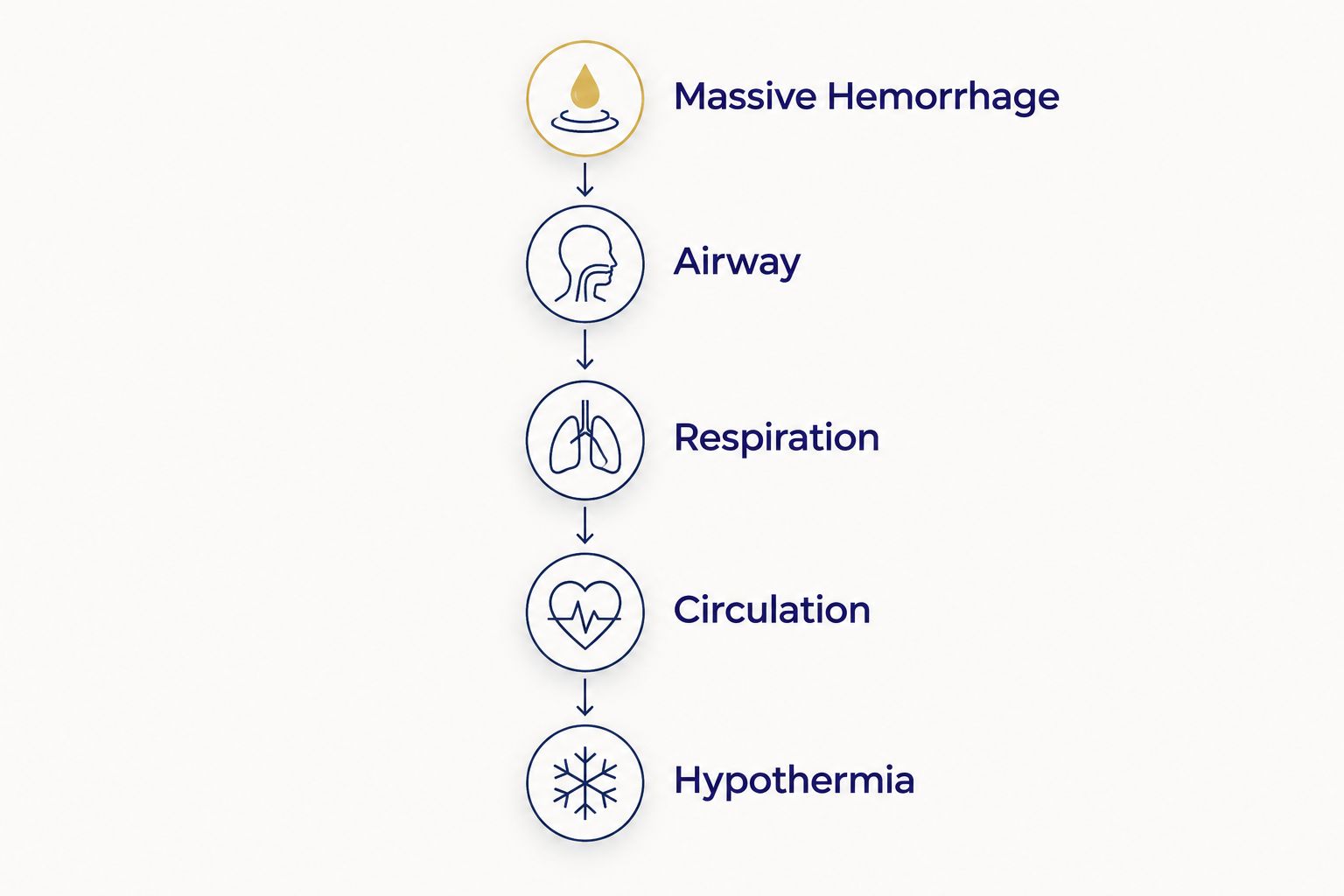
- MARCH protocol coverage — Massive hemorrhage, Airway, Respiration, Circulation, Hypothermia/Head injury all addressed, not just bleeding control.
- CoTCCC-recommended components — tourniquet, hemostatic gauze, and chest seal models that match current Committee on Tactical Combat Casualty Care guidance.
- Carry format matched to role — belt-mounted, plate-carrier pouch, vehicle-staged, or aid-bag format depending on the job.
- Casualty documentation — a way to track what was applied and when, for handoff to higher care.
- Field durability — components that hold up to weather, movement, and repeated access without degrading.
- Resupply simplicity — modular contents that are easy to restock after training or a real deployment.
Best IFAK kits in 2026 at a glance
| Kit | Best For | Standout Feature | Key Limitation |
|---|---|---|---|
| Mojo® Combat Lifesaver Bag (Multicam) | Military combat lifesaver duty | MARCH™ color-coded, icon-identified layout | Bag footprint too large for belt carry |
| Patrol Pair Kit | Law enforcement patrol | Dual-carry: officer-worn plus vehicle-staged | Two units to inspect and restock |
| HALO Bleed Control Pack | Budget-conscious individual carry | CoTCCC-recommended chest seal and pressure bandage | No splint or airway component |
| Mojo® Direct Action Aid Bag (Coyote Brown) | Direct-action teams in arid/field ops | Balances CLS-bag size against full aid-bag bulk | Overkill for single-casualty carry |
| Mojo® Direct Action Aid Bag (Black) | Urban and covert deployment | Same direct-action capacity in low-vis color | Same bulk trade-off as the Coyote build |
| BLS Resus Corner | Fixed-site team resuscitation staging | AED, oxygen, and manual ventilation staged together | Not portable — stays at a fixed post |
| Universal Splint Set | Extremity fracture stabilization add-on | Works on humerus, forearm, and lower-leg fractures | No hemorrhage control included |
How we ranked: MED-TAC International ranks IFAK kits on MARCH-protocol coverage, carry format fit, and CoTCCC alignment — not on unit price. A kit that scores low on one criterion, like the BLS Resus Corner's lack of portability, still earns a slot because it fills a mission gap the individual carry kits don't.
1. Mojo® Combat Lifesaver Bag (Multicam): best IFAK kit for military combat lifesaver duty
The Mojo® Combat Lifesaver Bag uses MARCH™ medical gear in a color-coded, icon-identified layout, so a combat lifesaver can locate hemorrhage-control, airway, and respiratory components under stress without reading labels. It's built for dismounted operations where one bag has to carry full-protocol coverage for more than one casualty.
Mojo® Combat Lifesaver Bag pros:
- MARCH™ color-coding cuts search time during a live bleed
- Multicam pattern matches standard field camouflage
- Capacity to resupply after a training cycle without repacking from scratch
Mojo® Combat Lifesaver Bag cons:
- Too bulky for a belt-mounted individual loadout
- Overbuilt for a single-patient, low-acuity call
Verdict: Buy — if the mission is dismounted combat lifesaver duty, not solo patrol carry.
2. Patrol Pair Kit: best IFAK kit for law enforcement patrol
The Patrol Pair Kit splits trauma coverage across two identical kits — one worn on the officer, one staged in the patrol vehicle — so a downed officer's partner has a second, matching kit within reach instead of relying on a single point of failure.
Patrol Pair Kit pros:
- Redundant coverage if the officer-worn kit is inaccessible
- Identical contents in both kits — no guessing which one has what
- Sized for a duty belt or vehicle door pocket
Patrol Pair Kit cons:
- Two kits to inspect and rotate stock on, not one
- No airway adjunct included — pairs well with a separate NPA
Verdict: Buy — for any patrol unit standardizing officer-plus-vehicle coverage.
3. HALO Bleed Control Pack: best IFAK kit for budget-conscious individual carry
The HALO Bleed Control Pack strips the loadout down to CoTCCC-recommended chest-seal coverage and a high-performance modular pressure bandage — the two components most likely to matter in the first minutes after a penetrating chest wound or major bleed.
HALO Bleed Control Pack pros:
- Lowest entry price in this list
- CoTCCC-recommended chest seal, not a generic substitute
- Compact enough for an ankle or plate-carrier pouch
HALO Bleed Control Pack cons:
- No splint or airway adjunct — hemorrhage and chest trauma only
- Not sized for multi-casualty response
Verdict: Buy — as a first IFAK or a supplemental chest-trauma add-on.
4. Mojo® Direct Action Aid Bag (Coyote Brown, Intermediate): best IFAK kit for direct-action teams in field environments
The Mojo® Direct Action Aid Bag sits between a compact combat-lifesaver bag and a bulkier advanced-care bag, giving a direct-action team medic more room than an individual IFAK without the weight of a full aid station.
Mojo® Direct Action Aid Bag pros:
- Coyote Brown pattern fits arid and field deployments
- Multi-mission layout scales from single casualty to small team
- Low-profile build compared to advanced care bags
Mojo® Direct Action Aid Bag cons:
- Too large for a single officer's daily patrol carry
- Requires a dedicated carrier — not belt-mountable
Verdict: Buy — for team medics running direct-action missions, not solo patrol.
5. Mojo® Direct Action Aid Bag (Black, Intermediate): best IFAK kit for urban and covert deployment
Same direct-action capacity as the Coyote Brown build, in a low-visibility black finish suited to plainclothes law enforcement, close-protection details, and urban operations where camouflage patterns stand out instead of blending in.
Mojo® Direct Action Aid Bag (Black) pros:
- Low-vis color for plainclothes and urban roles
- Identical MARCH-organized capacity as the field version
- Works for close-protection teams that need discretion
Mojo® Direct Action Aid Bag (Black) cons:
- Same size trade-off as the Coyote Brown build — not for solo carry
- Black finish is less useful in true field or arid conditions
Verdict: Buy — for urban and close-protection details; skip for arid field ops.
6. BLS Resus Corner: best IFAK kit for fixed-site team resuscitation staging
The BLS Resus Corner isn't an individual carry kit — it's a coordinated resuscitation station combining an AED, portable oxygen, and manual ventilation gear at a fixed post, for teams that need staged capability beyond what any IFAK can hold.
BLS Resus Corner pros:
- Combines AED, oxygen, and ventilation in one staged bundle
- Fills the gap between individual IFAKs and a full aid station
- Suited to range control points, stations, and command posts
BLS Resus Corner cons:
- Not portable — this stays at a fixed location
- Doesn't replace individual hemorrhage-control kits for patrol or field carry
Verdict: Buy — for a fixed post or range, not for individual carry.
7. Universal Splint Set: best IFAK kit add-on for extremity fracture stabilization
The Universal Splint Set handles what none of the six kits above do well — long-bone fracture immobilization for the humerus, forearm, and lower leg — and it's built to pair with an existing IFAK rather than replace one.
Universal Splint Set pros:
- Covers humerus, forearm, and lower-leg fractures with one set
- Small enough to add to an existing aid bag or vehicle kit
- Proven splinting design, not a single-use improvisation
Universal Splint Set cons:
- No hemorrhage, airway, or chest-trauma coverage at all
- Needs a separate IFAK to be a complete loadout
Verdict: Buy — as an add-on, not a standalone kit.


Which IFAK kit should you choose in 2026?
Default to the Mojo® Combat Lifesaver Bag (Multicam) if you need one loadout that covers the full MARCH protocol for military combat lifesaver duty. Law enforcement patrol units get better redundancy from the Patrol Pair Kit's officer-plus-vehicle split. Anyone building a first IFAK on a tight budget starts with the HALO Bleed Control Pack and adds a splint set later. The wrong move in 2026 is buying one oversized aid bag for every role on the roster — match the kit to the mission, then standardize across the department with MED-TAC International's catalog.
FAQ
What is the best IFAK kit for 2026?
The best IFAK kit depends on the role: the Mojo® Combat Lifesaver Bag wins for military combat lifesaver duty, the Patrol Pair Kit wins for law enforcement patrol, and the HALO Bleed Control Pack wins for budget-conscious individual carry in 2026.
Is a bigger IFAK always better than a compact one?
No — a bigger IFAK adds coverage but also adds bulk that slows access during a bleed. A patrol officer needs a compact, belt-mountable kit, while a team medic running direct-action missions can carry a larger aid bag.
What's the difference between an IFAK and a trauma bag like the Mojo Direct Action Aid Bag?
An IFAK is built for one casualty and one carrier; a trauma or aid bag like the Mojo® Direct Action Aid Bag holds more supplies for a small team over multiple casualties. Use an IFAK for individual carry and an aid bag for team-level response.
Does an IFAK need both a tourniquet and a chest seal?
Yes — the MARCH protocol treats massive hemorrhage and respiration as separate priorities, so a complete IFAK carries a windlass tourniquet for extremity bleeds and a chest seal for penetrating chest trauma, not one or the other.
How much gear does a law enforcement patrol IFAK need?
A patrol IFAK needs enough for one officer-down scenario: a tourniquet, hemostatic gauze, a pressure bandage, and a chest seal at minimum. The Patrol Pair Kit adds a second matching kit staged in the vehicle for redundancy.
What is the MARCH protocol and why does it matter for IFAK contents?
MARCH stands for Massive hemorrhage, Airway, Respiration, Circulation, and Hypothermia/Head injury — the order tactical medicine trains responders to treat casualties in. IFAK contents are built around covering each MARCH step, not just stopping bleeding.
Can civilians buy the same IFAK kits used by military and EMS?
Yes — kits like the HALO Bleed Control Pack and Universal Splint Set use the same CoTCCC-recommended components sold to military, law enforcement, and EMS buyers, and they're available to civilian first responders and preppers as well.
Is the BLS Resus Corner a substitute for an individual IFAK?
No — the BLS Resus Corner is a fixed-site resuscitation station with an AED, oxygen, and ventilation gear, meant to stage at a post or range. It complements individual IFAKs; it doesn't replace one for patrol or field carry.
One last thing
The detail most buyers miss: color matters as much as contents. The Mojo® Direct Action Aid Bag, part of MED-TAC International's lineup, ships in both Coyote Brown and Black for the same MARCH-organized capacity — pick the finish that matches the environment, not the one that looks best in a photo. A field-camo bag in an urban close-protection role prints as clearly as a black bag would in the desert.
Leave a comment