




Most tourniquet failures are slack left in the strap. The SAM XT's buckle takes the slack out for you — it does not take the training out.
At a glance
12 things to know about the SAM XT
What the buckle does, what the strap and windlass are made of, where the labeling draws its limits, and what the data show.
-
01
The buckle does the first half of the work
SAM's TRUFORCE™ buckle auto-locks at a predetermined circumferential force: pull the strap hard and steady and its locking prongs deploy through holes in the strap, taking out nearly all the slack before the windlass turns once.3,4,5
-
02
Why slack matters
In a manikin trial, failed tourniquet applications carried about three times the slack of successful ones — 10.5 mm against 3.2 mm. The SAM XT averaged 5.0 mm of slack, the C-A-T 5.2 mm and the SOFTT-W 9 mm.8
-
03
Predictable windlass turns
SAM states the design normalizes the number of windlass turns needed, which makes the device easier to train and more predictable to apply.3,4
-
04
A strap that does not depend on hook-and-loop
The Precision Strap is single-layer nylon webbing with spaced holes; the buckle prongs lock into those holes as the primary hold, and hook-and-loop only secures the leftover strap. SAM's point: hook-and-loop-dependent tourniquets can fail when wet or dirty.4
-
05
Machined aluminum windlass
The XT600's windlass rod is machined from 6061-T6 aluminum bar, and it locks into angled C-hooks.4 SAM also makes a polymer-windlass SAM XT (XT700) as a separate model.3,6
-
06
A plate that bends instead of breaking
The nylon TRUFLEX™ plate under the windlass spreads force as targeted pressure and is built to bend on smaller limbs without breaking.4
-
07
Built for weather and night vision
The time band's hook-and-loop is weather-resistant and works fully submerged, and the time band's outer material and the precision tab are optimized for night vision, and SAM states the tourniquet meets MIL-STD-810G for durability.4
-
08
Labeled for limbs 5.75 to 32.5 in.
SAM labels the SAM XT for first responders treating injured limbs 5.75 to 32.5 in. (14.6–82.6 cm) around, to control life-threatening bleeding where direct pressure is not effective or practical.5 Above that range, carry a tourniquet labeled for larger limbs.
-
09
evidence-based standard since the 2019 update
The evidence-based added new limb tourniquets in 2019, its first update since 2005, and its list names the SAM-XT under NSN 6515-01-670-2240 — SAM's Tactical Black XT600-BK-EN.2,3,7
-
10
What the head-to-head data show
With 60 military medicine cadets on a manikin leg, the SAM XT controlled bleeding in 73.3% of applications and the C-A-T in 67.7% — not a significant difference — at mean pressures of 186 and 175 mmHg.8 In a smaller test with four users, the C-A-T came out ahead on seven measures and the SAM XT on two, with small differences.9
-
11
It works over most clothing
Over nine clothing setups on a manikin leg, the SAM XT and the C-A-T always exceeded 180 mmHg; only leather motorcycle trousers raised blood loss for both.10 Over military cold-weather clothing, both reached 180 mmHg in almost every application.11
-
12
Three colors, one device
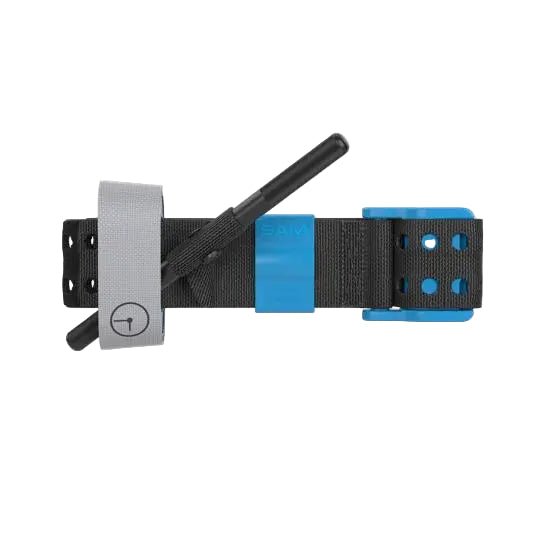
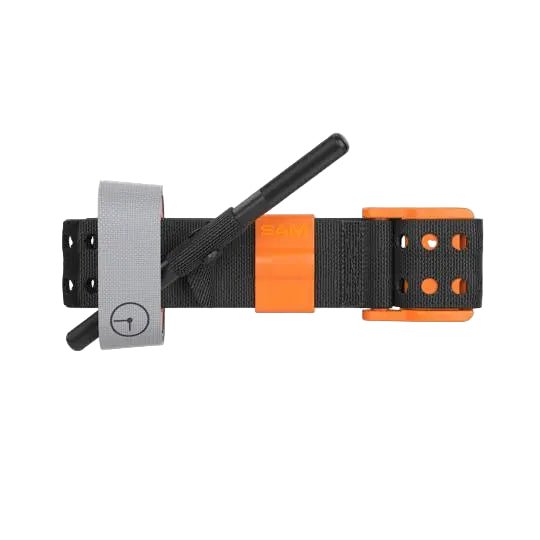
Tactical Black (XT600-BK-EN), Hi-Viz Orange (XT600-OR-EN) and Hi-Viz Blue (XT600-BL-EN) are the same XT600, each with its own part number and barcode.3,6 Hi-Viz Blue is a live tourniquet, not a trainer: SAM registers it as a single-use tourniquet exactly like the black and orange.5,6
How to apply the SAM XT
SAM's click, twist, secure sequence, with the placement decision made first.
-
1Choose the placement. Under threat, or when the injury site is not easily seen: hasty — high and tight on the injured limb, over clothing. When the source is found and time and safety allow: deliberate — directly on the skin, 2–3 in. above the wound. If that point lands on a joint, move above the joint. Never place it across or directly over a joint.1,5
-
2Route the strap. Place the SAM XT around the limb and insert the tip of the strap through the opening in the buckle. Nothing solid in a pocket may sit under the strap.5
-
3Pull until it clicks. Grip the strap close to the buckle and pull hard and steady until the buckle prongs deploy through the strap holes. Press the excess strap back on itself, keeping tension, without covering the windlass C-hooks.5
-
4Twist. Twist the windlass rod until the bleeding stops and the distal pulse is gone. It hurts — that is expected, and it is not a reason to loosen it.1,5
-
5Lock and check. Fix the rod inside the C-hooks and confirm the bleeding has stopped. If it continues, add twists; if that fails, apply a second SAM XT side by side with the first.1,5
-
6Secure and record. Wrap the excess strap between the C-hooks, over the rod and around the limb, close the time band over the C-hooks, and record the time of application.5
-
7Reassess a hasty tourniquet. Under TCCC, trained responders expose the wound when the scene allows. If a tourniquet is needed, place a second one on bare skin 2–3 in. above the bleeding site, tighten it, then slowly release the first. If the source still cannot be found, the first stays high and tight.1
-
8Leave it on — or convert by protocol. For civilians and most law enforcement, especially in self-aid, leave it on for the receiving clinicians; SAM's labeling says to remove or reposition it only under a medical practitioner's direction.5 Military protocol makes every effort to convert within 2 hours when the criteria are met.1
Where it fits
- Life-threatening bleeding from an arm or a leg where direct pressure is not effective or practical5
- Any traumatic amputation of an arm or leg — even one that is barely bleeding1
- Bleeding you cannot locate under threat: high and tight over clothing, then reassess1,5
- Limbs from 5.75 to 32.5 in. (14.6–82.6 cm) around5
- The groin, armpit or neck — pack those wounds with hemostatic gauze and hold pressure
- Across or directly over a joint — move above it
- Over keys, phones or other solid objects in clothing5
- Limbs larger than 32.5 in. around — outside the labeled range5
- Bleeding that direct pressure or a pressure dressing controls
The evidence
The studies behind the numbers above, what each one tested, and how strong it is.
| Study | Evidence type | What was studied | What it found |
|---|---|---|---|
| Kragh et al., Ann Surg 2009 | Human · combat clinical | Tourniquets as a class: 232 casualties with 428 tourniquets, Baghdad, 2006 (before the SAM XT existed) | Survival 90% when tourniquets were applied before shock vs 10% after; no limb lost because of a tourniquet |
| Katsnelson et al., Mil Med 2020 | Manikin · randomized | SAM-XT vs C-A-T Gen 7 vs SOFTT-W, 60 military medicine cadets, HapMed leg | Bleeding control 73.3% vs 67.7% (not significant) vs 35%; pressure 186 vs 175 vs 104 mmHg; slack 5.0 vs 5.2 vs 9 mm |
| Kragh et al., J Spec Oper Med 2018 | Manikin | SAM XT vs C-A-T, four users, simulated first aid | C-A-T better on 7 measures, SAM XT on 2, 12 ties; time to bleeding control 70 s vs 62 s; differences small |
| Lechner et al., BMC Emerg Med 2024 | Manikin · over clothing | C-A-T, SAM XT and SOFTT-W over nine clothing setups; trainer hired from SAM Medical | C-A-T and SAM XT always exceeded 180 mmHg; leather motorcycle trousers raised blood loss for both |
| Lechner et al., Int J Circumpolar Health 2023 | Manikin · cold-weather clothing | C-A-T Gen 7, SAM XT and SOFTT-W over military winter clothing | C-A-T and SAM XT reached 180 mmHg in almost all applications; SOFTT-W fell short in some setups |
| Montgomery et al., J Spec Oper Med 2019 | Expert review · evidence-based update | Review of limb tourniquets for the evidence-based's 2019 update | evidence-based voted to update its list in April 2019; the authors note the lack of unbiased data and official test criteria |
Strongest to weakest: human clinical data, then manikin studies, then expert review. The SAM XT's published head-to-head data are manikin studies; the human data in this table are for tourniquets as a class.15
How it compares
The three evidence-based standard windlass designs buyers most often weigh against each other.
| SAM® XT (XT600) | C-A-T® Gen 7 | TMT™ | |
|---|---|---|---|
| Maker | SAM Medical | C-A-T Resources; North American Rescue, U.S. distributor | Safeguard Medical |
| Slack removal | Auto-locking TRUFORCE™ buckle — pull until it clicks | Pull the band tight by hand, then fasten | Ratcheting pulls on the strap tail |
| Windlass | Machined 6061-T6 aluminum rod, C-hooks | Ribbed rod, ambidextrous clip | Torsion bar with audible lock |
| Labeled limb range | 5.75–32.5 in. (14.6–82.6 cm) | Up to 35 in. (88.9 cm) | 5.75–38 in. (14.6–96.5 cm) |
| Weight (manufacturer) | 4.4 oz packaged | 2.7 oz | 3.5 oz packaged |
| Head-to-head data | 73.3% bleeding control on a manikin leg vs 67.7% C-A-T — no significant difference8 | Better on 7 of 21 manikin metrics vs SAM XT's 2; 12 ties9 | Arm failure 19.4% vs 5.6% C-A-T in volunteers16 |
| evidence-based standard | Yes — SAM-XT | Yes — C-A-T Gen 7 | Yes — TMT |
SAM XT figures from SAM Medical;4,5 C-A-T figures from North American Rescue;12 TMT figures from Safeguard Medical.13 Volunteer and manikin results are not directly comparable.
Build the system
Carriers for a windlass tourniquet, the other evidence-based standard designs, and what goes in the kit beside it.


Questions buyers ask
Package & specifications
Available Options:
- Black
- Orange
- Blue
| Specification | Value |
|---|---|
| Width | 1.5 Inches |
| Length | 2.5 Inches |
| Height | 7.25 Inches |
| Weight | 3.8 Ounces |
Domestic & Military Shipping
Free Standard Shipping: Automatically applied at checkout on all orders $200 and above within the 48 contiguous United States (CONUS).
APO/FPO Military Addresses: Unconditionally free standard shipping on every order, with no minimum purchase required.
Order Processing & Tracking
Fulfillment Timeline: In stock merchandise ships within 48-72 hours from Florida HQ.
Automated carrier tracking details are emailed immediately upon shipment dispatch.
30-Day Returns & Medical Safety
Returns: Unused, unopened equipment in original manufacturer packaging is eligible for return within 30 days of delivery.
Bio-Safety Notice: To ensure sterility and patient safety, medical consumables with opened or broken tamper-evident seals cannot be returned.
Return Facility: MED-TAC International Corp., 15757 Pines Blvd, Suite 154, Pembroke Pines, FL 33027.
Export Compliance
North American Rescue (NAR) products and rifle hard armor plates are strictly restricted to US and APO/FPO addresses and cannot be exported internationally.
FREQUENTLY ASKED QUESTIONS
Customer Reviews


