


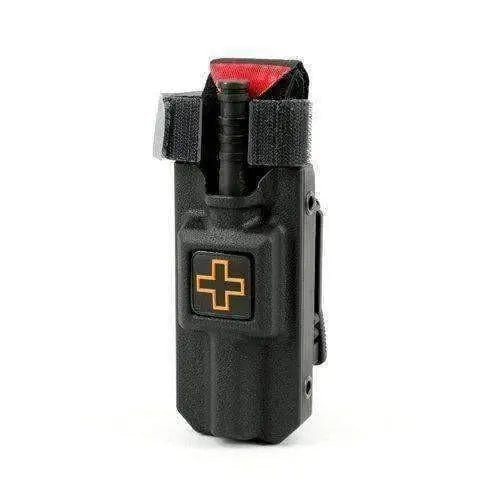
Choose the case for the tourniquet you actually carry, wear it where either hand can reach it, and draw it until the pull is automatic — the case only matters on the day the draw has to work.
At a glance
11 things to know about the RIGID TQ Case
Which tourniquets each case holds, how it mounts, what the evidence-based list covers, and the doctrine and evidence behind carrying a tourniquet this way.
-
01
A case — not a tourniquet
The case is a carrier. The tourniquet is purchased separately and is the only part that stops bleeding.3
-
02
One case for each tourniquet
Eleven 10 makes the C-A-T® case (holds Gen 7 and older generations), a SOF®TT case that holds the SOF®TT or the SOF®TT-Wide (including the latest generation), and a TMT™ case.3,4,5 Choose by the tourniquet on your person, and keep the tourniquet and the case together.
-
03
Friction holds it; a pull frees it
The case retains the tourniquet by friction, with no straps, buckles or flaps, and is designed to give your hand more contact with the tourniquet on the draw.3
-
04
Built to take abuse
The case is injection molded for rugged law-enforcement and military use, with a drainage hole at the base.3
-
05
Belt or MOLLE, your choice
The belt version uses a Blade-Tech TEK-LOK that fits a belt up to 2.25 in.; the MOLLE version uses a Tactical Tailor Malice Clip for MOLLE/PALS webbing.3
-
06
Carry it the way your gear needs
Many of the mounting solutions let the case ride vertical, horizontal, canted or inverted, so the height and angle can be set for the platform and the person.3
-
07
More mounts exist
Eleven 10 also builds the C-A-T® and SOF®TT cases in holster-mount configurations for right-hand Safariland® holsters, and sells hardware to mount the case on a Safariland® drop-leg shroud in the accessory position.3,4
-
08
Cover and shirt shield are optional
Eleven 10 sells a Jacket that covers the tourniquet against the elements and breaks away on the draw, and a Shirt Shield that keeps the exposed portion off the uniform shirt.6
-
09
What the evidence-based list says about the tourniquets
The list names the C-A-T Gen 7 (NSN 6515-01-521-7976), the SOFTT-W (6515-01-587-9943) and the TMT (6515-01-656-6191). The standard-width SOF®TT is not named in the December 2021 list, and the list does not rate cases.2
-
10
Reach decides how early it goes on
In a survey of 232 casualties with 428 tourniquets at a Baghdad combat hospital, survival was 90% when the tourniquet was used before shock and 10% after.11 In a pilot of 12 trained officers, C-A-T self-application succeeded 8 of 12 times under simulated hemorrhagic shock against 10 of 12 normally, with failures from insufficient tightening.12
-
11
Carrying is not training
Right after a course, people trained on the C-A-T applied it correctly 92.2% of the time on a manikin against 68.6% for the SOF-T and 11.8% for two other designs.13 Skill fades without practice.14 Drill with the exact case and the exact tourniquet.
How to choose, mount and use the case
Match the case to the tourniquet, set the carry position, then apply by the doctrine the case exists to serve.
-
1Match the case to the tourniquet. C-A-T® Gen 7 (or earlier generations), SOF®TT or SOF®TT-Wide, or TMT™ — each has its own case.3,4,5
-
2Pick the mount. TEK-LOK for belts up to 2.25 in.; Malice Clip for MOLLE/PALS webbing.3
-
3Seat the tourniquet. Set it fully in the case so the exposed portion is what your hand finds.3
-
4Set the position. Choose a carry position and angle you can reach with either hand, under stress, without looking.
-
5Choose the placement at the wound. Under threat, or when you cannot see where the blood is coming from: hasty — high and tight on the limb, over clothing. When the source is found and time allows: deliberate — on bare skin 2–3 in. above the wound. Never across or directly over a joint.1
-
6Tighten, lock, record. Tighten until the bleeding stops and the distal pulse is gone; if bleeding persists, tighten further or add a second tourniquet beside the first. Write down the time.1
-
7Restock. After any use, the case gets a fresh tourniquet before it goes back on the belt or carrier.
Where it fits
- Carrying a C-A-T® Gen 7 or earlier generation3
- Carrying a SOF®TT or SOF®TT-Wide4
- Carrying a TMT™5
- Duty belts up to 2.25 in. and MOLLE/PALS platforms3
- A tourniquet other than the one the case is cut for
- Groin, armpit or neck bleeding — pack the wound with hemostatic gauze and hold pressure
- Standing in for training: carrying is not practice
- Stand-alone bleeding control: with no tourniquet in it, it carries nothing
The evidence
The studies behind the doctrine above, what each one tested, and how strong it is.
| Study | Evidence type | What was studied | What it found |
|---|---|---|---|
| Kragh et al., Ann Surg 2009 | Human · combat clinical | Prospective survey of 232 casualties with 428 tourniquets on 309 limbs, combat support hospital, Baghdad, 2006 | Survival 90% when a tourniquet was used before shock vs 10% after; mortality 11% with prehospital vs 24% with emergency-department application; no limb lost because of tourniquet use |
| Tanaka et al., Prehosp Emerg Care 2026 | Human volunteer · pilot | 12 trained law enforcement officers in body armor self-applying a C-A-T to the non-dominant arm, with and without lower-body negative pressure simulating hemorrhagic shock | Application succeeded in 10 of 12 without and 8 of 12 with simulated shock; times did not differ; failures came from insufficient tightening despite correct placement |
| McCarty et al., JAMA Surg 2019 | Manikin · randomized crossover | 102 laypeople trained on the C-A-T applying five tourniquet types immediately after the course | Correct application: C-A-T 92.2%, SOF-T 68.6%, improvised 32.4%, SWAT-T 11.8%, RATS 11.8% |
| Goralnick et al., JAMA Surg 2018 | Human · randomized trial | 465 laypeople; correct tourniquet application in a simulated scenario after in-person training, retested at 3 to 9 months | 88% correct after a Bleeding Control Basic course vs 16% with no intervention; 54.5% of the 303 retested could still apply one |
| Evidence-Based Standard Devices & Adjuncts, Dec 2021 | Expert review | The committee's list of limb tourniquets, non-pneumatic | Names the C-A-T Gen 7 (6515-01-521-7976), SOFTT-W (6515-01-587-9943) and TMT (6515-01-656-6191); no case, holster or pouch appears |
Strongest to weakest: combat clinical data, then human-volunteer and training trials, then manikin studies. The studies concern the tourniquet and the skill of applying it, not the carrier; carrier specifications come from the manufacturer.
How it compares
Four ways to carry a windlass tourniquet on the belt line.
| RIGID TQ Case® (Cross Front) | IWB RIGID TQ Case® | TQ911 holster | TACO® Polymer Pouch | |
|---|---|---|---|---|
| Maker | Eleven 10® | Eleven 10® | S4 Solutions | High Speed Gear |
| Carry | On the belt (TEK-LOK, belts up to 2.25 in.) or MOLLE (Malice Clip) | Inside the waistband, Overhooks for 1.5 in. and 1.75 in. belts | On a duty, patrol or pistol belt up to 2.25 in. | Belts up to 2 in. or MOLLE, with two HSGI Universal Clips |
| Retention | Friction | Friction | Formed one-piece polymer shell, no cover10 | Adjustable shock cord |
| Tourniquets | C-A-T® Gen 7 and older; SOF®TT / SOF®TT-W; TMT™ (a case for each) | C-A-T® Gen 7 and older | C-A-T® Gen 7 | C-A-T, SOF®TT, SOF®TT Wide, SAM® XT |
| evidence-based standard | No — a case; the tourniquet inside is judged separately | No — a case; the C-A-T Gen 7 inside is | No — a holster; the C-A-T Gen 7 inside is | No — a pouch; the tourniquet inside is judged separately |
Figures from each manufacturer's product information.3,7,8,9,10
Build the system
The tourniquets these cases carry, other carriers, and what goes in the kit beside them.


Questions buyers ask
Package & specifications
Available Options:
- C-A-T® Gen 7 / Belt (TEK-LOK)
- C-A-T® Gen 7 / MOLLE (Malice Clip)
- SOF®TT / SOF®TT-W / Belt (TEK-LOK)
- SOF®TT / SOF®TT-W / MOLLE (Malice Clip)
- TMT™ / Belt (TEK-LOK)
- TMT™ / MOLLE (Malice Clip)
Specifications coming soon. Contact us for detailed product information.
Domestic & Military Shipping
Free Standard Shipping: Automatically applied at checkout on all orders $200 and above within the 48 contiguous United States (CONUS).
APO/FPO Military Addresses: Unconditionally free standard shipping on every order, with no minimum purchase required.
Order Processing & Tracking
Fulfillment Timeline: In stock merchandise ships within 48-72 hours from Florida HQ.
Automated carrier tracking details are emailed immediately upon shipment dispatch.
30-Day Returns & Medical Safety
Returns: Unused, unopened equipment in original manufacturer packaging is eligible for return within 30 days of delivery.
Bio-Safety Notice: To ensure sterility and patient safety, medical consumables with opened or broken tamper-evident seals cannot be returned.
Return Facility: MED-TAC International Corp., 15757 Pines Blvd, Suite 154, Pembroke Pines, FL 33027.
Export Compliance
North American Rescue (NAR) products and rifle hard armor plates are strictly restricted to US and APO/FPO addresses and cannot be exported internationally.
FREQUENTLY ASKED QUESTIONS
Customer Reviews


