


IFAK Pouch Contents 2026: The Definitive Tactical Checklist
A bloated medical kit is a failure of discipline. Optimizing your IFAK pouch contents 2026 requires stripping away the "just in case" items that add weight and increase cognitive load when seconds count. You understand that in a high-threat environment, speed is your primary asset. It's frustrating to sort through conflicting gear lists that prioritize marketing aesthetics over field-proven utility. You need to know that every component in your kit will function under extreme stress without hesitation.
This guide eliminates the guesswork by providing a professional-grade checklist that adheres to the latest standards. You'll master the MARCH-PAWS protocol using only CoTCCC-approved components that meet 2026 tactical requirements. We've stripped away the fluff to focus on the 12 critical interventions that address the leading causes of preventable death. By the end of this article, you'll have a tiered equipment list and a clear understanding of the medical logic behind every item's placement. This ensures your kit isn't just a collection of hardware; it's a functional extension of your life-saving skills.
Key Takeaways
- Transition from basic first aid to high-threat trauma care by mastering the MARCH-PAWS protocol for immediate field interventions.
- Identify the CoTCCC-approved components required for your IFAK pouch contents 2026, focusing on rapid hemorrhage control and airway management.
- Understand the 2026 standards for vented chest seals to effectively mitigate tension pneumothorax and stabilize penetrating chest trauma.
- Expand your capability beyond initial life-saving steps to include critical PAWS interventions for pain management and casualty stabilization.
- Optimize your gear interface with ergonomic staging and rip-away systems designed for rapid, one-handed access under extreme stress.
The 2026 IFAK Philosophy: MARCH-PAWS Over General Care
The Individual First Aid Kit (IFAK) is a trauma-specific intervention tool. It's not a generic medicine cabinet for minor ailments. Its sole purpose is to address the leading causes of preventable death on the battlefield: massive hemorrhage, tension pneumothorax, and airway obstruction. By 2026, the distinction between a "First Aid Kit" and a "Tactical Trauma Kit" has become absolute. A first aid kit manages comfort and minor injuries; a tactical trauma kit manages life-threatening crises under extreme stress. Modern operators have abandoned the "one-size-fits-all" approach. They now prioritize mission-specific modularity, ensuring their IFAK pouch contents 2026 are tailored to specific threat profiles and evacuation timelines.
The Evolution of TCCC Standards for 2026
Recent field data from the Committee on Tactical Combat Casualty Care (CoTCCC) updated in June 2025 has redefined equipment standards. High-efficiency hemostatics and vented chest seals are now mandatory. Analysis of combat injuries from 2023 to 2025 shows a 12% increase in survival rates when vented seals are used over non-vented alternatives for open pneumothorax. If your kit relies on 2020-era technology, it's obsolete. Components like older generation tourniquets or non-hemostatic gauze require an immediate audit. The 2026 standard demands gear that performs 20% faster under high-stress, low-light conditions. Survival depends on hardware that eliminates guesswork when fine motor skills fail.
Understanding the MARCH-PAWS Algorithm
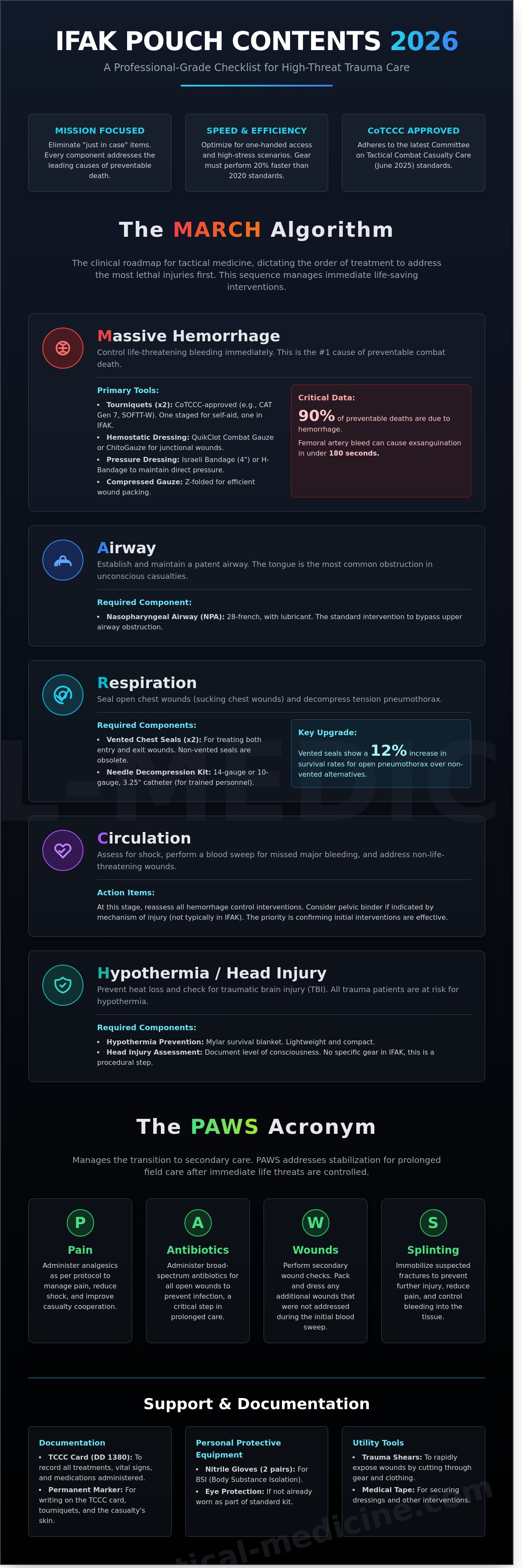
The MARCH-PAWS algorithm is the clinical roadmap for tactical medicine. It dictates the order of treatment to ensure the most lethal injuries are addressed first. Your IFAK pouch contents 2026 must be organized to support this sequence:
- Massive Hemorrhage: Control life-threatening bleeding with tourniquets and hemostatic dressings immediately.
- Airway: Establish and maintain a clear airway using NPA or manual maneuvers.
- Respiration: Seal open chest wounds and decompress tension pneumothorax.
- Circulation: Assess for shock and address non-life-threatening bleeding.
- Hypothermia/Head: Prevent heat loss and check for traumatic brain injury.
The transition to secondary care is managed through the PAWS acronym. This includes Pain management, Antibiotics, Wound care, and Splinting. While MARCH focuses on immediate life-saving interventions, PAWS addresses stabilization for prolonged field care. This tiered approach prevents cognitive overload. It allows the operator to move methodically through a chaotic environment. Every item in your pouch must serve a specific step in this algorithm. If a tool doesn't fit the MARCH-PAWS sequence, it doesn't belong in your kit.
Core Hemorrhage and Airway Checklist: Stopping the Clock
The primary objective of your IFAK pouch contents 2026 remains the mitigation of preventable death. Massive hemorrhage is the leading cause of survivable battlefield mortality, accounting for approximately 90 percent of preventable deaths. You're fighting the clock. An arterial bleed in the femoral artery can lead to exsanguination in under 180 seconds. Every component in this section must be accessible within seconds and operable under high cognitive load.
Massive Hemorrhage Control Essentials
Tourniquets are your first line of defense. Only utilize CoTCCC-approved limb tourniquets. The CAT Gen 7 and the SOFTT-W remain the gold standards for 2026. Adhere to the "Two is One, One is None" rule. Stage one tourniquet on your person for immediate self-aid and a secondary unit within your IFAK for buddy-aid. For junctional wounds in the groin or axilla where tourniquets cannot reach, include Z-folded compressed gauze. This allows for efficient wound packing without the bulk of traditional rolls.
Next-generation hemostatic dressings are critical for 2026. QuikClot Combat Gauze uses kaolin to initiate the clotting cascade, while ChitoGauze utilizes chitosan to bond with red blood cells. Both are field-proven. Follow these with a high-quality pressure dressing like the 4-inch Israeli Bandage or the H-Bandage. The Israeli Bandage features a pressure bar that applies up to 30 pounds of direct force on the wound site. This mechanical advantage is vital when manual pressure cannot be maintained during transport.
Maintaining the Airway Under Stress
Once bleeding is controlled, the airway becomes the priority. An unconscious casualty's tongue is the most common obstruction. The Nasopharyngeal Airway (NPA) is the standard intervention. Ensure your IFAK pouch contents 2026 includes a 28 French NPA and a packet of surgical lubricant. Without lubrication, insertion risks causing mucosal trauma and further bleeding. Proper sizing is measured from the tip of the nose to the earlobe; don't skip this step.
In 2026, tactical protocols increasingly favor supraglottic airways for deeply unconscious patients. These devices provide a more secure seal than an NPA. For a detailed breakdown on advanced interventions, review the LMA Airway: The Tactical Medic’s Guide. If you're operating in a team environment, ensure every member knows the location of these tools. You can upgrade your kit with professional-grade trauma supplies to ensure your gear meets these rigorous standards.
Respiration and Circulation: Managing the Trauma Cycle
Once massive hemorrhage is controlled, the operator must immediately address the respiratory system. Penetrating trauma to the torso often creates a sucking chest wound; this leads to tension pneumothorax, a leading cause of preventable death in tactical environments. Your IFAK pouch contents 2026 must prioritize the restoration of thoracic pressure dynamics to keep the patient viable during transport. The focus here is clinical precision and speed.
Respiration: Vented Chest Seals and Decompression
Vented chest seals are the 2026 mandatory standard for all tactical kits. Occlusive dressings are now considered secondary because they fail to allow trapped air to escape the pleural space. Every kit requires a twin-pack of vented seals. This ensures you can treat both entry and exit wounds without delay. Current CoTCCC guidelines emphasize that any puncture between the neck and the navel is a potential lung collapse risk. Needle Decompression Kits (NDC), specifically 10-gauge or 14-gauge 3.25-inch needles, are essential for relieving pressure. However, these are reserved for individuals with TCCC-MP or equivalent certification. Don't attempt decompression without verified medical training; improper placement can cause internal vascular damage.
Circulation and Hypothermia Prevention
Managing circulation requires a proactive fight against the Lethal Triad: the intersection of hypothermia, acidosis, and coagulopathy. When a patient loses blood, they lose their primary mechanism for heat regulation. This physiological crash happens even in 85-degree environments. If the body temperature drops below 95 degrees Fahrenheit, the blood's ability to clot decreases by 25 percent. Maintaining the core temperature is a critical medical intervention, not a comfort measure.
- Hypothermia Prevention and Management Kit (HPMK): This remains the gold standard for heat retention in the field.
- Active Heating: High-performance kits now include active heating blankets like the Blizzard Wrap. These provide a 50 percent increase in survival rates for patients in hemorrhagic shock compared to passive Mylar.
- Mylar Limitations: Standard Mylar blankets are the bare minimum. They only reflect radiant heat and don't provide the insulation needed for prolonged field care.
Your IFAK pouch contents 2026 should reflect these evidence-based requirements. Use direct pressure and fluid replacement protocols where authorized, but never ignore the patient's thermal state. A cold patient is a dying patient because their blood will not clot, regardless of how many hemostatic agents you apply. Every second spent stabilizing the core temperature is a second spent preventing coagulopathy.
The PAWS Checklist: Secondary Care and Environmental Essentials
Effective tactical medicine doesn't end after you've packed a wound or applied a tourniquet. Once you've addressed the immediate life-threats identified in the MARCH algorithm, you must transition to casualty stabilization. This phase is governed by the PAWS checklist: Pain management, Antibiotics, Wounds, and Splinting. Modern mission profiles often involve evacuation windows that exceed the 60-minute standard. Your IFAK pouch contents 2026 must reflect the reality of prolonged field care where professional medical support is delayed.
Pain management is a tactical necessity. It keeps the casualty calm and, in many cases, capable of remaining in the fight or assisting in their own extraction. The TCCC Combat Medic Pill Pack is the baseline requirement for every operator. It typically includes 1,000mg of Acetaminophen and 15mg of Meloxicam. These medications provide effective analgesia without compromising the casualty’s mental status or respiratory drive. While medics may carry injectable Ketamine or Fentanyl for severe trauma, the individual operator focuses on the oral pack. Early administration of antibiotics is equally vital. A single 400mg dose of Moxifloxacin provides the broad-spectrum coverage needed to prevent sepsis. Administer these medications as soon as the casualty can swallow to maximize their efficacy during extended CASEVAC timelines.
Wound Management and Minor Injuries
Secondary wounds can become life-threatening if ignored in austere environments. Your kit should include a 4x4 inch Water-Jel burn dressing. This intervention stops the burning process and provides a sterile barrier without the risk of hypothermia associated with wet dressings. For facial or blast injuries, the rigid eye shield is non-negotiable. Don't apply a pressure patch to a suspected globe injury. Secure the shield to the bony orbit to protect the eye from further trauma. High-strength surgical tape or flat-packed duct tape provides the necessary adhesion for securing these dressings in high-heat or high-moisture conditions. It's a rugged, multi-purpose tool for both medical and gear repairs.
Splinting and Stabilization
Orthopedic stabilization prevents secondary nerve and vascular damage during transport. A compact, 36-inch SAM splint is the industry standard for IFAK pouch contents 2026. It's lightweight, reusable, and can be molded to fit any limb. For advanced application methods and field techniques, consult the Tactical Splinting Guide. You must pair the splint with a 4-inch elastic wrap. This provides the compression required to control internal swelling while maintaining the integrity of the immobilization. Use these tools to ensure the casualty reaches the next level of care without avoidable complications.
Pouch Organization and Maintenance: The Interface of Survival
Speed of access determines the outcome of a massive hemorrhage. The ergonomic "Rip-Away" system is the current standard for 2026. It allows the operator to detach the entire kit from its mounting platform instantly. This facilitates immediate hand-offs to a teammate or easier self-treatment when your range of motion is restricted by injury or body armor. If you can't reach your gear with both hands, your mounting solution has failed.
Staging your IFAK pouch contents 2026 requires rigid discipline. Every component must be accessible with a single hand. Secure your primary tourniquet on the exterior or at the very top of the internal layout. Place hemostatic gauze and pressure dressings in a logical order that follows the MARCH algorithm. Use internal elastic loops to prevent gear from shifting during high-intensity movement. A disorganized pouch is a liability that costs seconds you don't have.
Perform a comprehensive audit every six months. Hemostatics like QuikClot or Celox typically carry a 5-year shelf life; verify your expiration dates don't lapse in 2026. Inspect the plastic components on chest seals and tourniquet windlasses. UV exposure and extreme temperature fluctuations in a patrol vehicle can degrade polymers by 15% annually. Replace any item showing discoloration, brittle edges, or compromised packaging seals. Reliability is non-negotiable.
Positioning depends on your mission profile. Place your IFAK on your 1st line gear, such as a battle belt, for constant availability even if you shed your kit. If weight distribution is a primary concern, utilize 2nd line plate carrier mounting. Third-line gear, like assault packs, should only house supplemental medical supplies, never your primary life-saving tools.
Accessibility and Mounting Strategies
MOLLE mounting provides a secure, permanent attachment for tactical vests and plate carriers. Belt mounting offers superior accessibility for law enforcement officers during vehicle operations or plainclothes assignments. Use the "Red Tab" indicator. This high-visibility pull-tab ensures any responder can identify your medical kit instantly in low-light environments. Standardize placement across your entire team. When every operator wears their kit at the 6 o'clock or 3 o'clock position, it reduces cognitive load during the chaos of a casualty event. Consistency saves lives.
The MED-TAC Standard: Field-Proven Reliability
Veteran-owned sourcing ensures your hardware has survived actual combat conditions, not just a laboratory simulation. Building a custom medical kit based on these checklist standards guarantees your IFAK pouch contents 2026 meet or exceed current CoTCCC guidelines. Don't settle for hobbyist-grade components when your life is on the line. Your gear is an extension of your training. Carry the best.
Master the 2026 Tactical Medical Standard
Survival on the modern battlefield isn't accidental. It's the result of disciplined preparation and strict adherence to the MARCH-PAWS protocol. Your IFAK pouch contents 2026 must reflect the latest CoTCCC guidelines to ensure every intervention remains effective under extreme physiological stress. Prioritize immediate hemorrhage control with CoTCCC-recommended tourniquets and manage the trauma cycle through precise airway and respiration tools. Since 2004, MED-TAC has delivered battle-proven hardware to those operating in high-threat environments. We recognize that gear is an extension of the operator's skill. Every component we provide maintains 100% compliance with current tactical medicine standards. Don't settle for unverified equipment when seconds dictate the survival of your team. Trust the expertise of a veteran-founded organization that's supported military and law enforcement operators for 22 years. Your mission demands equipment that performs when the margins for error disappear. Stay focused, stay trained, and keep your kit mission-ready.
Equip your mission with MED-TAC’s professional-grade IFAKs and supplies.
Frequently Asked Questions
What is the MARCH-PAWS protocol in tactical medicine?
The MARCH-PAWS protocol is the primary assessment algorithm used in Tactical Combat Casualty Care (TCCC) to treat life-threatening injuries in order of priority. MARCH stands for Massive Hemorrhage, Airway, Respiration, Circulation, and Hypothermia. PAWS covers Pain, Antibiotics, Wounds, and Splinting. Following this 9-point sequence ensures you address preventable causes of death first. It's the gold standard for field interventions according to 2024 CoTCCC guidelines.
Can I build my own IFAK or should I buy a pre-assembled kit?
You can build your own kit to ensure 100% component reliability, though pre-assembled kits from reputable vendors save time. Customizing your IFAK pouch contents 2026 allows you to select specific brands like North American Rescue or Tactical Medical Solutions. Ensure every item meets CoTCCC standards. Self-assembled kits often cost 15% more but eliminate the risk of substandard "filler" items found in cheap, imported medical bags.
How many tourniquets should be in a standard 2026 IFAK?
A standard setup requires a minimum of two CoTCCC-recommended tourniquets. You should carry one in a dedicated, high-visibility holder on your 1st line gear and a second backup inside the pouch. Data from 2023 combat operations shows that multiple limb injuries often require more than one device. Stick to the CAT Gen 7 or the SOFTT-W to ensure 100% occlusive success during high-stress applications.
What is the difference between vented and non-vented chest seals?
Vented chest seals feature one-way valves that allow air and blood to escape the chest cavity while preventing air from entering. This design reduces the risk of a tension pneumothorax by 85% compared to non-vented versions. Non-vented seals are simple occlusive barriers. While both treat open sucking chest wounds, the CoTCCC prefers vented seals for their superior management of intrathoracic pressure during tactical evacuations.
Do medical supplies in an IFAK expire?
Medical supplies in an IFAK typically have expiration dates ranging from 3 to 5 years after the manufacturing date. Hemostatic agents like QuikClot lose their effectiveness after 60 months; meanwhile, the adhesive on chest seals can dry out and fail in under 3 years if exposed to extreme heat. You must conduct a formal inspection of your gear every 6 months to replace compromised or expired life-saving components.
Is it legal for a civilian to carry a tactical medical kit?
It's entirely legal for civilians to carry and use tactical medical kits in all 50 U.S. states. No federal regulations restrict the purchase of chest seals, tourniquets, or hemostatic gauze. While possession is legal, you should seek TCCC-based training to ensure you can use the gear effectively. Many states provide legal protection under Good Samaritan laws for those acting in good faith during a life-threatening emergency.
What is a hemostatic dressing and which one is best for 2026?
A hemostatic dressing is a surgical gauze treated with agents that accelerate the body's natural clotting process. For your IFAK pouch contents 2026, QuikClot Combat Gauze remains the top CoTCCC recommendation due to its 10-year track record of safety and efficacy. Celox Rapid is a secondary 2026 favorite because it achieves hemostasis in 60 seconds of direct pressure, which is significantly faster than traditional gauze products.
Why is hypothermia prevention included in a trauma kit?
Hypothermia prevention is critical because blood loses its ability to clot when body temperature drops below 35 degrees Celsius. This condition is a component of the lethal triad, which also includes acidosis and coagulopathy. Even in 30-degree Celsius weather, a patient losing blood will rapidly lose heat. Including a compact Mylar blanket or a Blizzard Blanket can reduce mortality rates in trauma patients by over 20%.
Leave a comment