

1
/
3
SKU:
FIN-0001-04
Type:
Wound Closure
Vendor:
RevMedX

PRODUCT INFORMATION
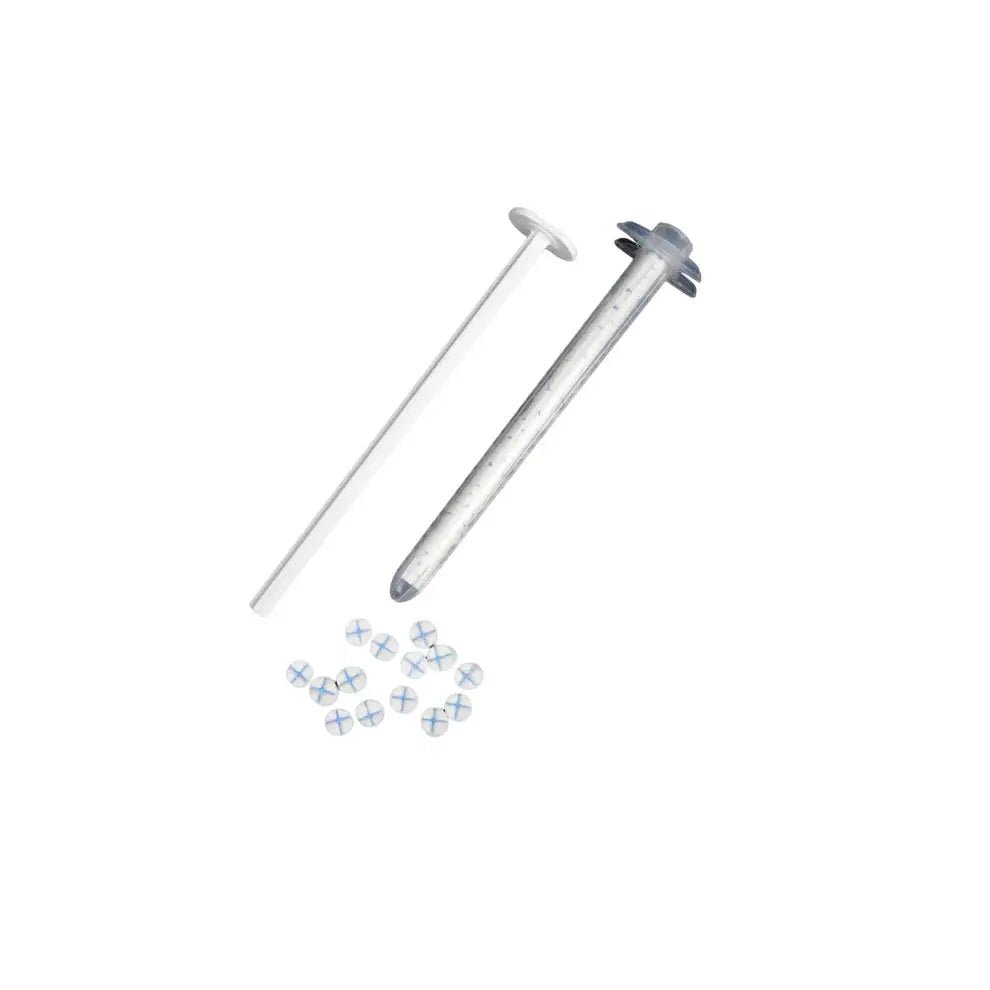
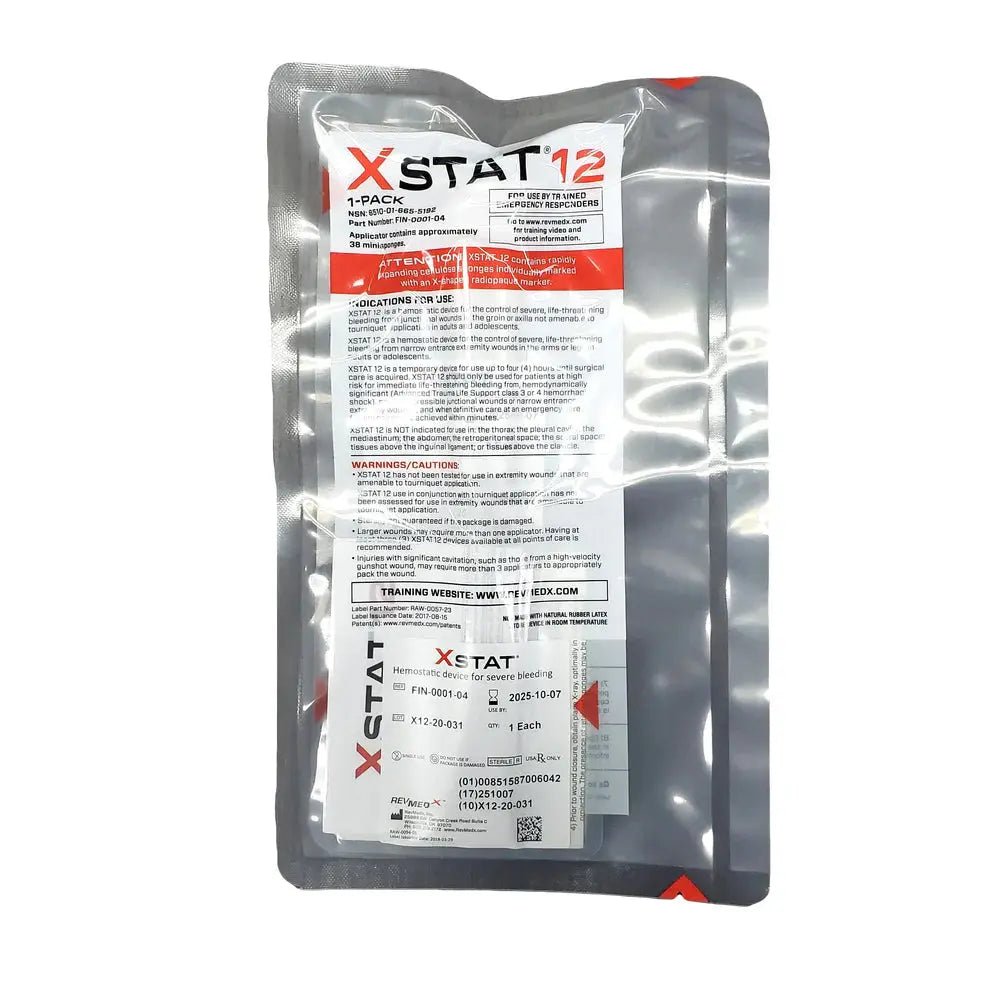
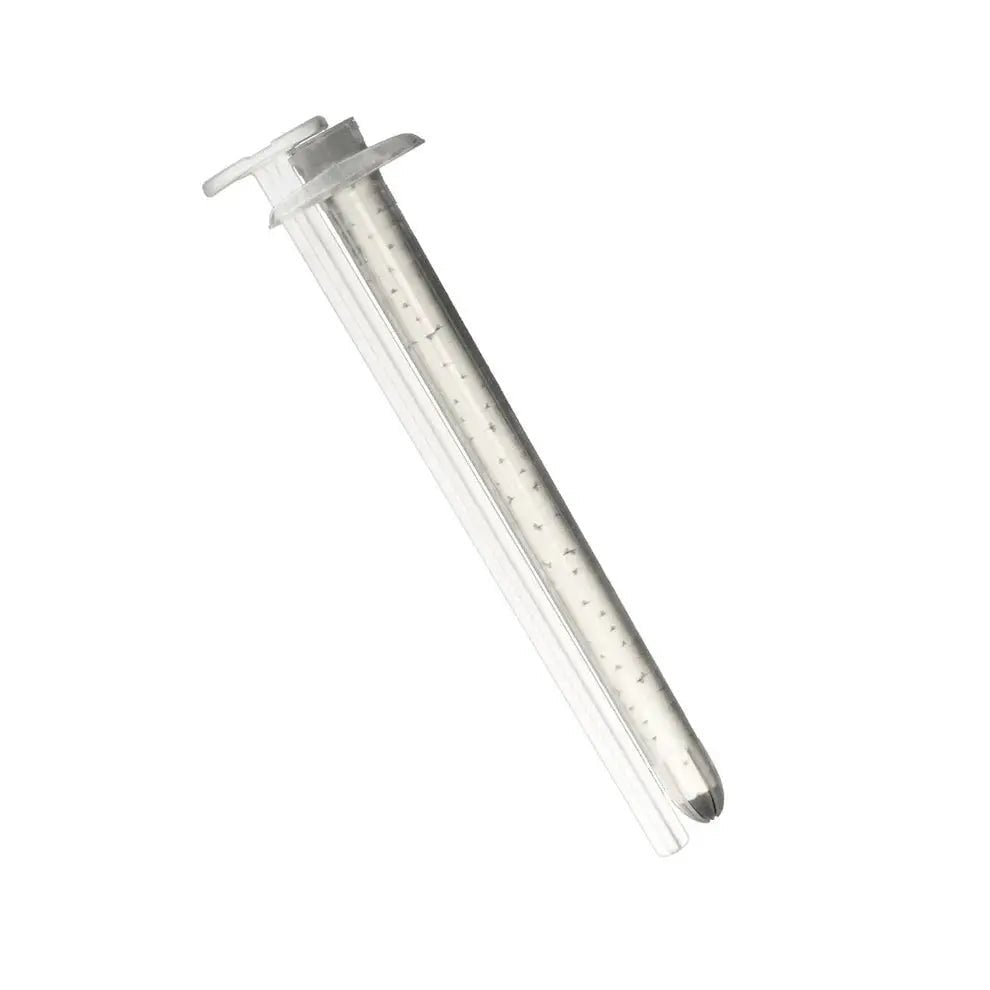
The XSTAT P12 Wound Dressing (MFR Part: FIN-0001-04, NSN: 6510-01-665-5192) by RevMedX is a CoTCCC-recommended, FDA-cleared injectable hemostatic device for rapid control of severe, life-threatening external bleeding from junctional wounds in the groin or axilla — areas not amenable to tourniquet application. The 12 mm diameter syringe-style applicator injects approximately 36 rapidly-expanding compressed cellulose sponges coated with chitosan directly into the wound tract within seconds. Each sponge expands up to 10× its compressed size on contact with blood, filling the wound cavity from the inside and creating hemostatic pressure without the need for sustained manual compression. Each sponge is individually marked with a radiopaque X-shaped marker for X-ray detection and complete removal confirmation. Sterile, single-use, vacuum-sealed. Prescription device — for use by trained emergency responders and medical professionals.
MARCH Phase: M — Massive Hemorrhage Control | CoTCCC-Recommended | FDA-Cleared
Key Specifications
| Specification | Detail |
|---|---|
| Manufacturer | RevMedX |
| MFR Part Number | FIN-0001-04 (Single Pack) |
| NSN (Single Pack) | 6510-01-665-5192 |
| NSN (Three Pack) | 6510-01-657-4737 |
| Applicator Diameter | 12 mm (P12) — designed for narrow-tract penetrating wounds |
| Sponge Count per Applicator | ~36 compressed cellulose mini-sponges |
| Sponge Expansion Ratio | Up to 10× compressed size within ~20 seconds of blood contact |
| Sponge Material | Non-absorbable, compressed cellulose sponges coated with chitosan |
| Radiopaque Marker | X-shaped radiopaque marker embedded in each sponge — visible on X-ray |
| Pressure Generated | ~10–15% above MAP (mean arterial pressure) — sufficient for hemostasis |
| Temporary Use Duration | Up to 4 hours until definitive surgical care |
| FDA Status | FDA-cleared (510(k) / De Novo), Class II — 21 CFR 878.4452 |
| CoTCCC Status | CoTCCC-recommended for compressible external hemorrhage not amenable to tourniquet |
| Sterilization | Sterile, vacuum-sealed, single-use applicator |
| Military Deployment | Currently fielded by the U.S. Military |
| Prescription Status | Rx only — 21 CFR 801.109; for use by trained emergency responders / medical professionals |
| SKU at MED-TAC | FIN-0001-04 |
How XSTAT P12 Works — The Science of Injectable Hemostasis
Controlling hemorrhage from a narrow, deep junctional wound in the groin or axilla has historically been one of the most challenging problems in emergency hemorrhage management. Gauze packing requires 3 minutes of sustained direct pressure — difficult or impossible under fire, in a vehicle, or during movement. Junctional tourniquets work for some anatomical locations but cannot address every wound geometry. The XSTAT P12 was engineered to fill this gap.
Step 1 — Insertion
The syringe-style applicator (12 mm diameter) is placed into the wound tract as close as possible to the source of bleeding. The narrow profile allows access to penetrating wound tracks too small for the larger XSTAT 30 applicator.
Step 2 — Injection
The plunger is depressed, injecting approximately 36 compressed cellulose mini-sponges coated with chitosan into the wound cavity. Each sponge is individually packaged in a compressed state — small enough to travel the wound tract but engineered to expand significantly once deployed.
Step 3 — Expansion
Within approximately 20 seconds of contact with blood, each sponge expands up to 10× its compressed volume. The expanding sponges collectively fill the wound cavity, creating internal pressure of approximately 10–15% above mean arterial pressure — sufficient to stop hemorrhage from the inside out without relying on the rescuer to maintain sustained compression.
Step 4 — Hemostasis & Cover
Once the cavity is packed (additional applicators can be used sequentially if needed), apply 3 minutes of manual pressure over the wound and cover with an occlusive pressure dressing. Document XSTAT use on the casualty card. Transport to surgical care within 4 hours.
Chitosan Coating: Each mini-sponge is coated with chitosan, a naturally derived biopolymer with hemostatic and antimicrobial properties. Chitosan promotes platelet aggregation and facilitates clot formation on the sponge surface, augmenting the physical pressure mechanism with a biochemical hemostatic effect. Unlike some hemostatic agents, XSTAT contains no exothermic chemical agents — it does not generate heat on contact with blood.
Key Features
CoTCCC-Recommended — Validated for Tactical Combat Casualty Care
The XSTAT 12 is CoTCCC-recommended for compressible external hemorrhage not amenable to limb tourniquet use and as an adjunct to tourniquet removal when conversion is clinically indicated. It is specifically called out in TCCC Guidelines as a tool for the management of junctional hemorrhage — the same life-threatening wound geometry responsible for a significant portion of preventable combat deaths.
The XSTAT 12 is CoTCCC-recommended for compressible external hemorrhage not amenable to limb tourniquet use and as an adjunct to tourniquet removal when conversion is clinically indicated. It is specifically called out in TCCC Guidelines as a tool for the management of junctional hemorrhage — the same life-threatening wound geometry responsible for a significant portion of preventable combat deaths.
12 mm Profile — Access Where Other Devices Cannot Reach
The P12 applicator is specifically designed for entrance wounds and narrow-tract penetrating trauma — small-caliber rounds, stab wounds, and shrapnel injuries that create wound tracks too narrow for the XSTAT 30 (30 mm diameter). This smaller profile extends XSTAT's injectable hemostasis capability to wound geometries that were previously only manageable with gauze packing under sustained compression.
The P12 applicator is specifically designed for entrance wounds and narrow-tract penetrating trauma — small-caliber rounds, stab wounds, and shrapnel injuries that create wound tracks too narrow for the XSTAT 30 (30 mm diameter). This smaller profile extends XSTAT's injectable hemostasis capability to wound geometries that were previously only manageable with gauze packing under sustained compression.
No Sustained Compression Required — Critical Under Fire
Standard hemostatic dressings (Combat Gauze, Celox, ChitoGauze) require 3 minutes of direct pressure after packing. On a moving casualty, in a vehicle, under fire, or during single-rescuer scenarios, maintaining 3 minutes of uninterrupted pressure is operationally difficult. XSTAT P12 achieves hemostasis through internal pressure — apply, confirm packing, cover with pressure dressing, and move. Studies showed XSTAT required significantly less application time (31 vs. 65 seconds) and reduced blood loss compared to gauze packing in preclinical models.
Standard hemostatic dressings (Combat Gauze, Celox, ChitoGauze) require 3 minutes of direct pressure after packing. On a moving casualty, in a vehicle, under fire, or during single-rescuer scenarios, maintaining 3 minutes of uninterrupted pressure is operationally difficult. XSTAT P12 achieves hemostasis through internal pressure — apply, confirm packing, cover with pressure dressing, and move. Studies showed XSTAT required significantly less application time (31 vs. 65 seconds) and reduced blood loss compared to gauze packing in preclinical models.
Radiopaque Markers — Complete Sponge Removal Confirmation
Each of the ~36 mini-sponges contains an embedded X-shaped radiopaque marker. Before surgical closure, a plain X-ray in at least two projections confirms all sponges have been removed from the wound cavity. The X pattern is highly distinctive on radiograph, making retained sponge identification reliable. This design feature was specified by the FDA as a safety requirement for an internal-use temporary device.
Each of the ~36 mini-sponges contains an embedded X-shaped radiopaque marker. Before surgical closure, a plain X-ray in at least two projections confirms all sponges have been removed from the wound cavity. The X pattern is highly distinctive on radiograph, making retained sponge identification reliable. This design feature was specified by the FDA as a safety requirement for an internal-use temporary device.
Intuitive Applicator — Minimal Training Footprint
The XSTAT P12 uses a telescoping syringe-style applicator — pull the handle away from the barrel to prepare, insert into the wound tract, push the handle to deploy. The mechanics are consistent with existing medical syringe training. XSTAT has been evaluated by the military as fast to learn and intuitive to use under stress, which is why it has been fielded broadly by the U.S. military for combat casualty management.
The XSTAT P12 uses a telescoping syringe-style applicator — pull the handle away from the barrel to prepare, insert into the wound tract, push the handle to deploy. The mechanics are consistent with existing medical syringe training. XSTAT has been evaluated by the military as fast to learn and intuitive to use under stress, which is why it has been fielded broadly by the U.S. military for combat casualty management.
FDA-Cleared & Currently U.S. Military Fielded
XSTAT 12 achieved FDA clearance as a Class II device under 21 CFR 878.4452. It is currently fielded by the U.S. military and has been used in actual combat casualty care. This is not a training-only device or pre-clinical prototype — it is an operationally deployed hemostatic intervention with a real-world track record.
XSTAT 12 achieved FDA clearance as a Class II device under 21 CFR 878.4452. It is currently fielded by the U.S. military and has been used in actual combat casualty care. This is not a training-only device or pre-clinical prototype — it is an operationally deployed hemostatic intervention with a real-world track record.
Indications and Contraindications
Indicated For
- Junctional wounds in the groin (inguinal) not amenable to tourniquet application
- Junctional wounds in the axilla (armpit) not amenable to tourniquet application
- Adults and adolescents
- Narrow-tract penetrating wounds (entrance wounds, small-caliber, stab wounds)
- High-risk patients: ATLS Class 3–4 hemorrhagic shock, non-compressible wounds when definitive care is not immediately available
- As an adjunct to tourniquet conversion (TCCC guideline)
NOT Indicated For
- Thorax or pleural cavity
- Mediastinum
- Abdomen or retroperitoneal space
- Sacral space above the inguinal ligament
- Tissues above the clavicle (neck wounds)
- Extremity wounds amenable to limb tourniquet application
Who Is This For?
Combat Medics & 68Ws
CoTCCC-recommended and U.S. military fielded. Addresses the junctional hemorrhage problem that accounts for a significant proportion of preventable combat deaths. Applies in seconds without sustained compression — actionable under fire and during movement.
Special Operations Medics (18D / SARC / PJ)
The narrow applicator profile and rapid deployment make XSTAT P12 an efficient addition to the SOF medic's aid bag alongside conventional hemostatic dressings and junctional tourniquet systems. Multiple applicators can be used in the same wound cavity if needed.
Law Enforcement Tactical Medics & TEMS
Law enforcement active shooter response and high-risk entry operations generate the same wound patterns as combat. TEMS providers and tactical medics operating under TCCC/TECC protocols will encounter junctional wounds where XSTAT P12 is the optimal pre-hospital intervention.
EMS Providers & Trauma Nurses
FDA-cleared for civilian pre-hospital and emergency use. EMS systems and trauma nurses responding to penetrating trauma with junctional hemorrhage in the groin or axilla have a direct FDA-cleared indication. The Rx-only classification requires appropriate provider credentials and medical direction.
Emergency Physicians & Trauma Surgeons
For providers receiving XSTAT-treated casualties: X-ray in two projections to identify all retained sponges before wound closure. Sponges are removed manually with forceps under direct visualization. NSN stocking supports hospital trauma bay supply chain integration.
Civilian Prepared Responders & BCON Units
Bleeding Control for the Injured (BCON) programs and civilian emergency preparedness units operating with medical direction can incorporate XSTAT P12 into advanced bleeding control kits. Browse MED-TAC's public access bleeding control kits for context on bleed control hierarchy.
Why XSTAT P12 for Junctional Hemorrhage Management
Junctional wounds — those at the groin (inguinal), axilla (armpit), and neck — account for a disproportionate share of preventable hemorrhagic deaths in both military and civilian penetrating trauma. Extremity wounds amenable to tourniquet are survivable if the tourniquet is applied quickly. Junctional wounds are not. The anatomy prevents tourniquet application; the wound depth and geometry prevent effective manual compression and rapid gauze packing.
XSTAT P12 targets this exact problem. By injecting hemostatic sponges that expand inside the wound and create pressure from within, it achieves the same physiological goal as manual compression — but from inside the wound cavity, without requiring the provider to maintain hands-on pressure for 3 minutes. In a combat or active shooter scenario, those 3 minutes are the difference between staying with one casualty and managing multiple. In a single-rescuer scenario, they may be unavailable entirely.
Preclinical data demonstrated that XSTAT required approximately half the application time of gauze packing (31 vs. 65 seconds) and significantly reduced total blood loss during the application period. These findings contributed to its CoTCCC recommendation status and subsequent military fielding.
XSTAT P12 is stocked at MED-TAC International alongside the full massive hemorrhage control product line including hemostatic agents, tourniquets, and pressure dressings — enabling procurement of a complete MARCH-M intervention capability from a single authorized supplier.
Important Clinical Notes
Surgical Removal Required: XSTAT sponges are non-absorbable. All sponges must be removed surgically at a facility with capability to achieve proximal hemorrhage control. Do not attempt to remove sponges in the field.
X-ray Confirmation: Prior to wound closure, obtain plain X-ray in at least two projections to confirm complete sponge removal. The radiopaque X-marker pattern in each sponge is visible under standard imaging. Retained sponges can be missed — thorough radiographic review is required.
Temperature Monitoring: The sponge material may elicit a mild pyrogenic response. Monitor the patient for fever, chills, hypotension, and signs of septic shock post-application.
Applicator Tip Integrity: If the applicator tip breaks off during use, record the event on the casualty card. Do not attempt to retrieve a detached tip from the wound in the field.
4-Hour Limit: XSTAT is indicated for temporary use up to 4 hours until definitive surgical care. Plan evacuation timelines accordingly. Coordinate with receiving surgical facilities that XSTAT has been applied.
Frequently Asked Questions
What is the difference between the XSTAT P12 and the XSTAT 30?
The XSTAT 30 has a 30 mm diameter applicator and approximately 90 sponges per applicator — designed for larger wound cavities and exit wounds. The XSTAT P12 (also called XSTAT 12) has a 12 mm diameter applicator with approximately 36 sponges per applicator, designed specifically for narrow-tract entrance wounds, small-caliber gunshots, stab wounds, and junctional areas that are too narrow to access with the XSTAT 30. The P12 is the preferred choice for most penetrating wound geometries in tactical settings.
Does XSTAT P12 contain a hemostatic agent like chitosan or kaolin?
The XSTAT P12 sponges are compressed cellulose sponges coated with chitosan — a naturally derived biopolymer that promotes platelet aggregation and facilitates clot formation. Chitosan is not an exothermic reactive agent; it does not generate heat on blood contact. The primary hemostatic mechanism is physical pressure from sponge expansion filling the wound cavity, with the chitosan coating providing a hemostatic surface for clot formation.
Is XSTAT P12 CoTCCC-recommended?
Yes. The XSTAT 12 (P12) is CoTCCC-recommended for the management of compressible external hemorrhage not amenable to limb tourniquet use. It is specifically listed in TCCC Guidelines as a recommended tool for junctional hemorrhage management — groin and axillary wounds — and as a possible adjunct to tourniquet-to-alternative-method conversion when clinically appropriate.
Can multiple XSTAT P12 applicators be used in the same wound?
Yes. Trained responders may apply multiple applicators sequentially into the same wound until the cavity is completely filled. The goal is to pack the wound to the same density as gauze packing — approximately 1–2 inches above the wound surface. Additional applicators are used if bleeding is not controlled after the first. Up to three applicators have been studied in junctional wounds.
How are the XSTAT sponges removed after application?
XSTAT sponges must be removed surgically by a surgeon with the capability and equipment to achieve proximal hemorrhage control. They are removed manually and/or with forceps under direct visualization. X-ray confirmation in two projections is required before wound closure to confirm complete removal. Sponges are non-absorbable — they will not dissolve or be safely retained in the body. Do not attempt field removal.
Who can purchase and use the XSTAT P12?
XSTAT P12 is an FDA-classified prescription (Rx-only) device under 21 CFR 801.109. Sale, distribution, and use are restricted to physicians and trained medical professionals. In practice, this includes physicians, PAs, NPs, paramedics, military combat medics (68W, 18D), TEMS/TECC providers operating under medical direction, and EMS agencies with appropriate protocols. Civilian purchase requires evidence of training and medical direction authorization. MED-TAC International sells to qualified medical and tactical providers.
What is the shelf life and storage requirement for XSTAT P12?
XSTAT P12 is vacuum-sealed and sterile. Refer to the lot-specific expiration date printed on the individual package. Store in a cool, dry location away from direct heat, moisture, and UV light. Do not use any applicator with a compromised package seal. As with all sterile single-use medical devices, expiration compliance is a patient safety requirement — include XSTAT in your regular kit audit and rotation schedule alongside tourniquets and hemostatic dressings in your IFAK system.
All products sourced from the actual brand manufacturer or authorized master distributors. CoTCCC recommendation status verified where applicable. Ships from MED-TAC International, Pembroke Pines, FL — clinician-founded, veteran-led, SDVOSB-certified.
SPECS & MEASUREMENTS
| Specification | Value |
|---|---|
| Width | 6.9 Inches |
| Length | 1.3 Inches |
| Height | 11.1 Inches |
| Weight | 0.13 Lbs. |
| Dimensions | 0.32 Liters |
FREQUENTLY ASKED QUESTIONS

Shopping cart
