Product information

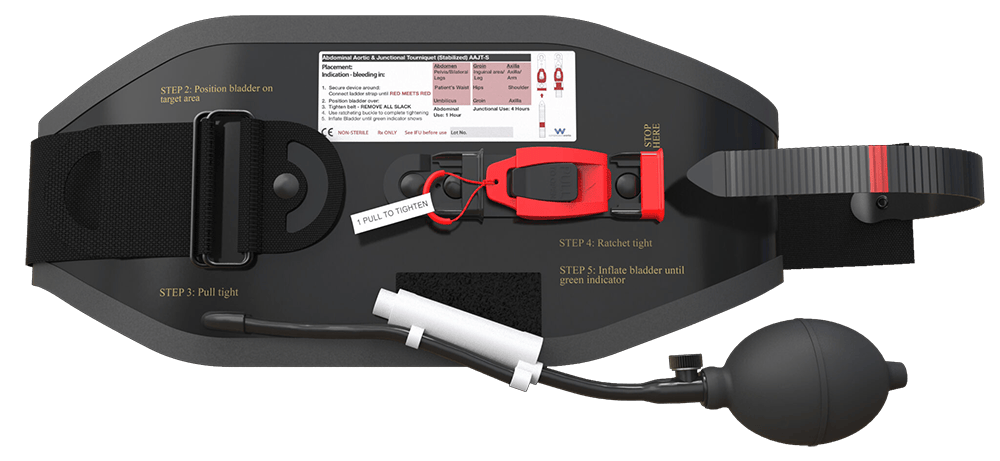
The AAJT-S is the abdominal aortic and junctional tourniquet–stabilized. It is the world’s only multi-functional lifesaving tourniquet for application in the axilla, on the abdomen, in the inguinal region for control of junctional and pelvic bleeding and for pelvic fracture stabilization and Zone 3 REBOA.
The Abdominal Aortic and Junctional Tourniquet – Stabilized (AAJT-S) is the latest life-saving innovation for bleeding not amenable to standard tourniquet application. Building on the success of the AAJT, the AAJT-S features an easy-to-use tightening system and advanced materials with the goal of consistent, stable occlusion.
The AAJT-S is indicated to control difficult bleeding in the primary junctional areas (inguinal and axillary) as well as the pelvis- the only product on the market to be approved for all three. In addition, it’s the only device to have documented lives saved from both upper and lower junctional hemorrhage.
The AAJT-S device design and function facilitates a large area of effective occlusion pressure, which provides the medic with a high degree of accuracy and reliability for the positioning of the device in the proper anatomical locations to stop the bleeding. In addition, the AAJT-S has demonstrated the ability to maintain efficacy during patient movement in confined space rescue, drags, and hasty extraction.
FEATURES:
- Lightest, most compact junctional tourniquet on the market
- Easy to use and quick to apply.
- Large area of effective pressure for greater reliability
- Provides stable and complete occlusion of blood flow to the lower extremities, upper extremities, or pelvis.
- Can be applied at junctional sites (inguinal, axillary) or mid-abdomen.
- Demonstrated ability to remain in place and effective during patient movement.
- Similar hemostatic efficacy to Zone 3 REBOA1
- Lower training burden compared to REBOA procedure.

Dimensions:
- Packaged: L 9 in. x W 8 in. x D 2 in.
- Stored: L 7.5 in. x W 6.5 in. x D 2 in.
- Weight: 17 oz
Resources - Clinical Articles
Greenfield, E.m., et al.
Annals of Emergency Medicine, vol. 54, no. 3, 2009, doi:10.1016/j.annemergmed. 2009.06.230.
Lyon, M., et al.
Annals of Emergency Medicine, vol. 58, no. 4, 2011.
Lyon, M., et al.
J Trauma Acute Care Surg 2012; 73 (2 Suppl) S103-2.
Taylor, David M., et al.
“The Evaluation of an Abdominal Aortic Tourniquet for the Control of Pelvic and Lower Limb Hemorrhage.”
Military Medicine, vol. 178, no. 11, 2013, pp. 1196–1201.
Croushorn, J et al.,
“Abdominal Aortic Tourniquet Controls Junctional Hemorrhage From a Gunshot Wound of the Axilla.”
Journal of Special Operations Medicine, Vol 13, Edition 3, Fall 2013, pp 1-4.
Lyon, Matthew, et al.
Prehospital Emergency Care, vol. 19, no. 3, 2014, pp. 405–408.
Croushorn, J et al.
Journal of Special Operations Medicine, Vol 14, Edition 2, Summer 2014, pp 6-8.
Gordon, R.d., and M. Lyon
Annals of Emergency Medicine, , vol. 64, no. 4, 2014.
Rall, Jason, et al.
“Hemodynamic effects of the Abdominal Aortic and Junctional Tourniquet in a hemorrhagic swine model.”
Journal of Surgical Research, Vol 212, 15 May 2017, pp 159-166.
Rall, Jason, et al.
Military Medicine, vol. 182, no. 9, 2017.
Brännström, Andreas MD; et al.
Journal of Trauma and Acute Care Surgery, October 2018, Volume 85, Issue 4, pp 717-724.
Khan, Mansoor, et al.
“Novel Use for the Abdominal Tourniquet in the Management of Postpartum Hemorrhage.”
Journal of the Royal Army Medical Corps, vol. 164, no. 6, 2018, pp. 463–463.
Rall, Jason M., et al.
Journal of Surgical Research, vol. 226, 2018, pp. 31–39.
Schwartz RB, Shiver SA, Reynolds BZ, Lowry J, Holsten SB, Akers TW, Lyon M.
J Spec Oper Med, Volume 19, Number 2, pp69-72, Summer, 2019.
Rall, Jason, et al.
Circulation. 2019;140:A268.
Handford, Charles, and Paul J. Parker
Journal of Special Operations Medicine: a Peer Reviewed Journal for SOF Medical Professionals, 19.4 (2019): 74-79.
Brännström, et al.
Journal of Trauma and Acute Care Surgery, October 2019, Volume 87, Issue 4, pp 849-855.
Stigall, Kyle; Sleeter, Justin Jay; Blough, Perry; Rall, Jason; Kauvar, David S.
Journal of the American College of Surgeons, Volume 231, Issue 4, Supplement 1, 2020, Page S310.
Schechtman, David W. MD; Kauvar, David S. MD; De Guzman, Rodolfo; Polykratis, I. Amy BS; Prince, M. Dale BS; Kheirabadi, Bijan S. PhD; Dubick, Michael A. PhD
Journal of Trauma and Acute Care Surgery, February 2020 – Volume 88 – Issue 2 – p 292-297.
Balian, Fay, et al.
Resuscitation, Volume 156, 2020, Pages 210-214.
Rall, Jason et al.
Abstract, Journal of the American College of Surgeons, Volume 231, Issue 4, S310. Full article, Journal of Special Operations Medicine, Vol 21, Edition 2, Spring 2021.


HOW IT WORKS
SEAL is a fast-acting, easy-to-use hemostatic spray that stops bleeding in seconds
1
IDENTIFY THE WOUND
Quickly locate the source of bleeding and prepare to apply SEAL spray.
2
SPRAY DIRECTLY
Apply SEAL directly to the wound from a distance of 2-3 inches. Cover the entire wound surface.
3
GEL FORMATION
SEAL instantly forms a protective gel barrier over the wound, halting blood flow in seconds.
4
EASY CLEANUP
When medical help arrives, SEAL can be easily wiped away for wound treatment.
PROVEN SCIENCE
FDA-CLEARED FOR OTC USE
BUILT ON PROVEN SCIENCE
FORMS A GEL BARRIER ON CONTACT
WHY CHOOSE SEAL?
SEAL outperforms traditional bleeding control methods
TRUSTED BY PROFESSIONALS
SEAL is the preferred choice across multiple sectors
MILITARY
Deployed for battlefield medicine and combat casualty care
LAW ENFORCEMENT
Essential for patrol officers and tactical units
FIRE RESCUE
Rapid response for emergencies and disaster situations
EMS
Critical for pre-hospital care and patient transport
WILDERNESS
Vital for remote locations and outdoor adventures
FREQUENTLY ASKED QUESTIONS
Everything you need to know about SEAL
What is SEAL Hemostatic Spray?
SEAL is an FDA-cleared hemostatic spray designed to rapidly stop bleeding. It works by forming a gel barrier over the wound upon contact, instantly halting blood flow while promoting the natural clotting process.
How does SEAL work?
SEAL uses a proprietary formula that reacts with blood to instantly form a protective gel barrier. This barrier physically stops bleeding while simultaneously activating the body's natural clotting factors, providing both immediate and sustainable hemostasis.
Is SEAL safe to use?
Yes, SEAL is FDA-cleared for over-the-counter use. The formula is non-toxic and does not cause tissue damage. It has undergone rigorous testing to ensure safety and effectiveness in a variety of applications.
Can SEAL be used on all types of wounds?
SEAL is designed for external use on minor to moderate wounds. It should not be used on severe arterial bleeding that requires immediate medical attention, deep puncture wounds, or internal injuries. As with any medical product, consult with a healthcare provider for serious injuries.
How long does SEAL last once applied?
SEAL's gel barrier remains effective for up to 24 hours. However, it's recommended to seek professional medical care as soon as possible. The barrier can be easily removed when proper wound treatment is available.
What's the shelf life of SEAL?
SEAL has a shelf life of 3 years from the date of manufacture when stored properly. Each canister is marked with an expiration date. Store at room temperature away from direct sunlight and extreme heat for maximum effectiveness.
My Wishlist
Wishlist is empty.
Compare
Shopping cart