




The most common tourniquet failure isn’t the device — it’s the application. Slack left in the strap before the windlass means turn after turn just taking up looseness instead of occluding, and under stress that wasted motion costs seconds and sometimes costs the occlusion entirely. A tourniquet that’s “on” but not tight enough is a tourniquet that didn’t work.
How many windlass turns are you wasting on slack — while the clock runs on the bleed?
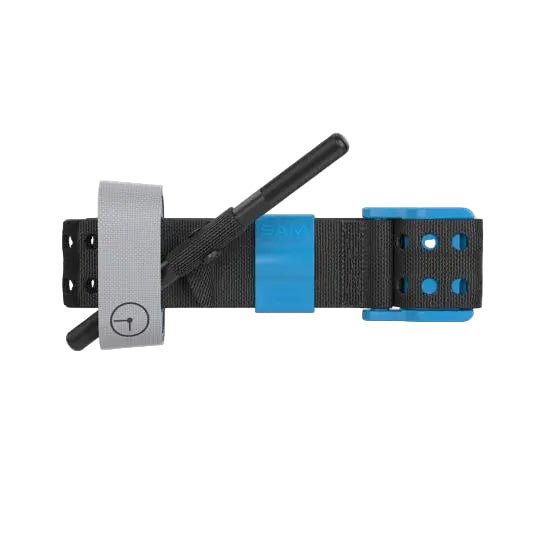
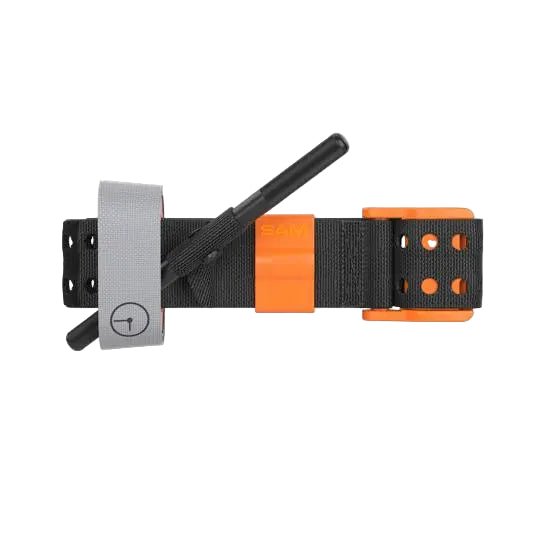
The SAM XT removes the guesswork. Its TRUFORCE™ auto-locking buckle engages automatically once the strap reaches the correct pretension, so you start the windlass already tight against the limb — fewer turns, faster occlusion, and far less of the slack error that defeats other tourniquets. It is the same proven windlass principle, made more foolproof under stress.
Engineered To Be Hard To Get Wrong
TRUFORCE™ Auto-Locking Buckle
Engages at the correct pretension automatically — you begin the windlass already snug, not fighting slack.
Fewer Windlass Turns
Because the strap pre-tensions, occlusion takes fewer turns — faster application, lower training burden.
Intuitive To Teach
The auto-lock makes correct application more repeatable across a unit of mixed experience levels.
Stiffened Strap
Holds shape for fast routing around a limb, even gloved or one-handed.
Windlass Retention
Locks the windlass at full occlusion so the device stays tight through movement and transport.
3 Duty Colors
Black for duty carry, Orange for visibility, Blue for training and identification.
How It Goes On
Place
High and tight on the limb, 2–3 in above the wound — never over a joint.
Thread
Route the strap through the buckle and pull — the TRUFORCE™ buckle locks at correct pretension.
Twist
Turn the windlass until bright-red bleeding stops and the distal pulse is gone.
Lock
Secure the windlass in its retention clip so it can’t unwind.
Mark
Write the time of application and reassess.
For an unknown or junctional wound, default to high and tight on the limb. Application is a perishable skill — train it live and re-train it. This is a summary, not a substitute for hands-on instruction.
Faster To Apply Only Matters If You’ve Trained It
The SAM XT’s auto-lock lowers the error rate — but it does not replace training. The advantage shows up when a unit drills the sequence to reflex: pre-tension, twist, lock, mark, and confirm loss of distal pulse every single time. Train it until it’s automatic and the design pays you back in seconds saved at the moment they decide the outcome.
Who Carries It
Military & Unit Medics — fewer windlass turns and a lower error rate across a unit of mixed experience.
Law Enforcement & SWAT — fast, foolproof duty-carry hemorrhage control.
EMS & Tactical EMS — a CoTCCC-recommended limb tourniquet built to apply right under stress.
Training Programs — an intuitive mechanism that lowers the time and reps needed to reach competence.
Build The Bleeding-Control Layer
A tourniquet is one layer. Carry it where you can reach it and back it with the rest of the bleeding-control answer:
Pick your color & cut the guesswork
Black, Orange, or Blue. Genuine SAM Medical, shipped from a clinician-founded, veteran-led team.
Key Specifications
| Manufacturer | SAM Medical |
| Device Type | Windlass limb tourniquet |
| CoTCCC Status | Recommended (limb tourniquet) |
| Buckle | TRUFORCE™ auto-locking |
| Key Benefit | Pre-tensions the strap; fewer windlass turns to occlusion |
| Colors | Black, Orange, Blue |
| SKUs | Black XT600-BK-EN | Orange XT600-OR-EN | Blue XT600-BL-EN |
| Single-Use | Live units are single-patient; train with a dedicated trainer |
Frequently Asked Questions
Is the SAM XT CoTCCC-recommended?
Yes. The SAM XT is on the CoTCCC-recommended list for extremity hemorrhage control. We verify recommendation status where applicable.
What does the TRUFORCE buckle actually do?
It auto-locks once the strap reaches the correct pretension, so you start the windlass already tight against the limb. That removes the slack error that defeats many tourniquet applications and reduces the number of windlass turns to occlusion.
Does that mean I can skip training?
No. The auto-lock lowers the error rate, but correct placement (high, tight, off the joints), confirming loss of distal pulse, and marking the time are still trained skills. Drill it to reflex.
How is it different from a CAT or SOF?
All three are CoTCCC-recommended windlass tourniquets. The SAM XT’s distinguishing feature is the auto-locking buckle that pre-tensions the strap; the SOF emphasizes a metal windlass; the CAT is the long-standing issue standard. Any of the three, trained and carried, is a sound choice.
Where do I place it?
High and tight on the limb, 2–3 inches above the wound, never over a joint. Tighten until bright-red bleeding stops and the distal pulse is gone, then lock the windlass and mark the time.
Evidence & Training Rationale
Uncontrolled extremity hemorrhage is a leading preventable cause of trauma death, and rapid, correct tourniquet application is the highest-yield response. The SAM XT earned CoTCCC recommendation as a windlass limb tourniquet, with a design specifically aimed at the most common failure mode in the field: leaving slack in the strap before windlassing.
The TRUFORCE™ auto-locking buckle addresses that directly. By engaging at a set pretension, it ensures the windlass begins working against an already-snug strap rather than taking up looseness — fewer turns, faster occlusion, and a more repeatable result across operators of differing skill. That repeatability is the clinically meaningful claim, especially for units training large numbers of people to competence.
MED-TAC’s position is educator first, operator second. A faster mechanism is only an advantage in trained hands. Place the tourniquet proximal and off the joints, confirm loss of distal pulse, mark the time, and rehearse the sequence until it is automatic. The device lowers the error rate; training closes the rest of the gap.
Related searches: SAM XT tourniquet, SAM XT extremity tourniquet, SAM Medical tourniquet, TRUFORCE buckle tourniquet, CoTCCC tourniquet, auto locking tourniquet, windlass tourniquet, limb tourniquet, military tourniquet, EMS tourniquet
This product is sourced directly from SAM Medical, the manufacturer of the SAM XT. CoTCCC recommendation status verified where applicable. Ships from MED-TAC International, Pembroke Pines, FL — clinician-founded, veteran-led, SDVOSB-certified.
Available Options:
- Black
- Orange
- Blue
| Specification | Value |
|---|---|
| Width | 1.5 Inches |
| Length | 2.5 Inches |
| Height | 7.25 Inches |
| Weight | 3.8 Ounces |
FREQUENTLY ASKED QUESTIONS
Customer Reviews


