Editor's note (September 2026): clinical statements in this 2017 article have been checked against the current Tactical Combat Casualty Care (TCCC) Guidelines (Joint Trauma System / CoTCCC, 01 May 2026) and the cited studies, and updated where doctrine or the evidence has changed.
Free PDF · Instant download · TCCC 2026
Download the MARCH Algorithm Field Guide
10 pages, free: one page per letter with steps for any responder and for trained providers, common errors, what to carry, a printable quick card, a kit checklist and a reassessment log. Aligned to the TCCC Guidelines of 01 May 2026. Clinical review: Marco R. Torres, MD, NRP.
The PDF opens as soon as you submit. You'll also get MED-TAC emails; unsubscribe anytime.
The MARCH algorithm is synonymous with Tactical Combat Casualty Care (TCCC). It is a simple acronym for remembering the necessary steps in priority for saving lives in combat. M-massive hemorrhage, A-airway, R-respiratory, C-circulation, and H-head injury/hypothermia.
RecentlyEMS1.compublished an article about the concept of theMARCH algorithm. While it is well known that civilian trauma and prehospital care advances greatly from military medicine during wars, at times, there is a failure of understanding about the meaning and reasoning behind the military’s rationale.
This article has a mix of concepts, assessments and treatments. It seems the author was applying MARCH to current trauma knowledge used in EMS. There are many areas where the article is spot on. However, there are a couple areas where information is incorrect or false. In other areas, it is vague and may leave the reader wondering why it’s done this way. Here is where the article could improve its message.
“MARCH is found in the tactical combat casualty care and advanced trauma life support courses.”
From what can be found, the MARCH acronym is most likely a UK invention. A thorough internet search failed to properly identify the origin. However, when a senior retired medical NCO, who is extremely familiar with TCCC was asked, he mentioned it was first heard around 2008 out of the UK military.
Advanced Trauma Life Support (ATLS) protocols were developed to standardize trauma resuscitation and provide a reliable method for the management of trauma patients. However, ATLS has never used the MARCH algorithm, this has always been a TCCC/military term. MARCH is used to identify and treat the major causes of preventable death. Among U.S. combat deaths in Iraq and Afghanistan from 2001 to 2011, 87.3% occurred before the casualty reached a medical treatment facility (Eastridge et al., J Trauma Acute Care Surg, 2012; n=4,596 deaths). We have an opportunity to save a small percentage of those casualties by using a methodical algorithm that allows for identification and immediate treatment of the life-threatening wounds.
MASSIVE HEMORRHAGE
“Massive hemorrhage can be addressed by the four Ds:
Detect: find the source of the bleeding.
Direct pressure: hold pressure on the source of the bleeding until the clot forms.
Devices: if necessary, use equipment such as tourniquets, hemostatic gauze and pressure bandages to supplement direct pressure.
Don’t dilute: use the concept of hypotensive resuscitation to avoid thinning the blood or pumping established clots.”
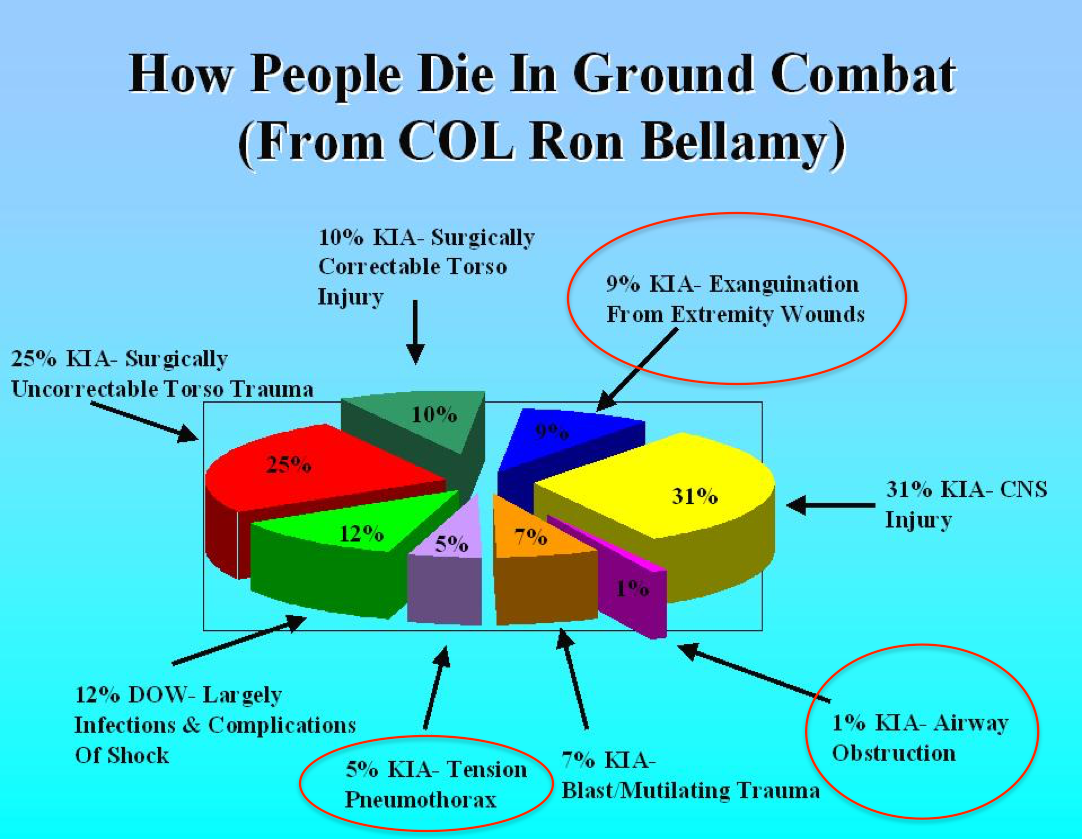
Figure 1 Bellamy RF. The causes of death in conventional land warfare: implications for combat casualty care research. Mil Med. 1984;149(2):55–62. Based on the Wound Data Munitions Effectiveness Team (WDMET) during the Vietnam War between 1967 and 1969.
Massive hemorrhage is strictly about massive hemorrhage, the treatments include tourniquet application, which should be the first treatment applied in true massive hemorrhage. It is not unreasonable to apply a pressure bandage, if you do it should be a hemostatic dressing for compressible hemorrhage not amenable to limb tourniquet use or as an adjunct to tourniquet removal. Junctional tourniquets and XSTAT® are also options in the current TCCC Guidelines for hemorrhage that a limb tourniquet cannot control.
Hemorrhage is the leading cause of preventable death in combat. Bellamy (Figure 1) found that massive hemorrhage from extremities comprised over 9% of the all deaths in Vietnam. However, of the leading three causes of preventable death, it was about 60%. Similarly, Eastridge et al. (Figure 2) found that 90.9% of potentially survivable prehospital deaths were associated with hemorrhage (976 potentially survivable deaths).
This is directly relatable to the civilian sector. Since 2001, approximately 2 million U.S. civilians have died from trauma, and the National Academies estimated that as many as 20% of the 147,790 U.S. trauma deaths in 2014 — nearly 30,000 in a single year — may have been preventable (National Academies of Sciences, Engineering, and Medicine, A National Trauma Care System, 2016). Hesitation to immediately address massive hemorrhage is a significant reason to immediately apply a tourniquet.
The easiest, quickest, and most efficient method of hemorrhage control is by tourniquet application. If after addressing life threats, it is determined that the hemorrhage did not need a tourniquet, it can be converted. In a prospective study of 232 combat casualties with 428 tourniquets, no limbs were lost because of tourniquet use and tourniquet duration was not associated with increased morbidity (Kragh et al., J Trauma, 2008). The TCCC Guidelines direct that tourniquets be converted in less than 2 hours when bleeding can be controlled by other means, and that non-medical (ASM/CLS) personnel not attempt conversion beyond 2 hours without medical direction. Finally, there is no discussion of fluid resuscitation during the identification and treatment of massive hemorrhage.
Figure 2 Eastridge BJ, Mabry RL, Seguin PG, et al. Death on the battlefield (2001–2011): implications for the future of combat casualty care. Journal of Trauma 2012, 73(6) Suppl 5: 431–7
AIRWAY CONTROL
“A reminds us that airway is still key care element for severe traumatic injuries. BLS to ALS, the patient needs a patent airway to survive.”
This tells me nothing about what to do with an airway, how to assess it or how to treat issues that arise. It does seem to imply it is appropriate to simply take a patient’s airway when the paramedic or EMT sees fit. Which also rolls into respiratory. If a patient can breathe on their own and maintain their own airway, they should. In a registry study of 13,625 patients with moderate to severe traumatic brain injury, prehospital intubation was associated with decreased survival (Davis et al., J Trauma, 2005), and a military case series of rapid sequence intubation in trauma patients reported frequent pulseless arrest after the procedure (cited in TCCC Change 24-1).
In Bellamy’s data, airway obstruction accounted for 1% of all deaths. Eastridge et al. found it caused 8.0% of potentially survivable deaths, which was 1.6% of all lethal pathology — so the overall share is similar, but airway obstruction remains the second leading cause of potentially survivable death and deserves more attention than “the patient needs a patent airway.” There are three types of patients that may present. The first is the unconscious casualty without a traumatic airway obstruction; TCCC Change 24-1 replaced the jaw thrust with the recovery position, head tilted back and chin away from the chest.
The conscious casualty with an airway obstruction or impending airway obstruction should be allowed to assume any position that best protects the airway, including sitting up and leaning forward, and suction should be used if available. If these measures fail and the traumatic obstruction is unmanageable, a surgical cricothyroidotomy (cric) is required (TCCC Guidelines, 2026). The NPA now sits in the respiration section, as an adjunct to bag-valve-mask ventilation. This is a major difference between the military and civilian medicine, but should be considered in EMS. The skill of intubation is difficult to teach and even more difficult to maintain. A cric is a comparatively simple surgical procedure, but TCCC Change 24-1 reports military cricothyrotomy success rates as low as 68% and calls documented military prehospital success rates unacceptable, so placement must be confirmed with continuous capnography.
Maintaining proficiency requires deliberate, repeated training. Which technique should you use? An early report by the Cric-Key’s inventor described a higher success rate and faster placement than the traditional open technique (Levitan, J Spec Oper Med, 2014), but a later randomized manikin study of 25 Navy corpsmen found the Control-Cric system (Cric-Key and Cric-Knife) slower, less successful and less preferred than the alternatives (Dorsam et al., Prehosp Emerg Care, 2019). TCCC Change 24-1 removed the Control-Cric as the preferred device, and the 2026 Guidelines specify a bougie-aided or standard open surgical technique. In civilian medicine, even the thought of a cric is frowned upon and may have some people asking questions.
There are various reasons for this, but in trauma, it may be a good option versus oral intubation (another EMS skill that has come under scrutiny in the last few years).
RESPIRATORY SUPPORT
“Assisting the patient with, or taking over respirations can move more air while simultaneously decreasing the patient’s respiratory effort using so much oxygen.”
Where is the assessment of the respiratory system to identify any thoracic trauma? The primary goal of the respiratory assessment is identifying penetrating chest trauma and a possible sucking chest wound. Once a chest seal has been applied, you should continue to monitor for a tension pneumothorax. Bellamy and Eastridge again have differing numbers: 5% of all deaths and 1.1% of potentially survivable deaths (11 of 976), respectively.
This could be for a variety of reasons, one possible explanation is the increased protection from body armor during the wars in Iraq and Afghanistan. Relating this to EMS, there might be a closer resemblance to Bellamy’s data and have a requirement for increased needle decompressions. In the military, the threshold for needle decompression is low. The current TCCC Guidelines call for it when a casualty has significant torso trauma or primary blast injury plus one or more of: severe or progressive respiratory distress, severe or progressive tachypnea, absent or markedly decreased breath sounds on one side, oxygen saturation below 90%, shock, or traumatic cardiac arrest without obviously fatal wounds.
This is due to the lack of certain types of medical equipment in combat. Typically, a stethoscope is not carried and one must rely on other methods to evaluate the pulmonary system. The TCCC Guidelines specify a 14-gauge or 10-gauge, 3.25-inch needle/catheter at either the 5th intercostal space in the anterior axillary line or the 2nd intercostal space in the midclavicular line. Needle decompression is not risk-free — iatrogenic injury, including cardiac penetration, has been reported (case report) — but if a tension pneumothorax is present, decompression can relieve it and save the patient’s life.
This is another skill that is frowned upon in EMS. There is utilization of chest seals in EMS, but rarely will a patient receive a needle decompression. In my eight years in EMS, I did exactly two. In fairness, fatal tension pneumothorax is not always immediate — in Vietnam data, 15 of the 26 casualties who died of it lived long enough to receive first aid (McPherson et al., J Trauma, 2006) — and many inner-city services reach the trauma center quickly. Finally, there is no discussion on the use of end tidal CO2, pulse oximetry, the use of supplemental oxygen, all of which are used to monitor or treat a casualty.
He does get this right, but probably should have been mentioned sooner in his article.
“Keep in mind that over-ventilation can also do more harm than good. Ventilation provided with too much volume, speed or force can increase pressure in the chest, reducing blood return to the heart. This can have a negative effect on circulation, especially on trauma patients progressing towards shock.”
CIRCULATION
“The C in MARCH refers to shock. After massive hemorrhage, airway and breathing have been addressed, we need to optimize the patient’s circulation. Standard methods for circulation improvement, such as laying the patient flat, maintaining body temperature and careful fluid resuscitation all apply.”
This entire paragraph is wrong, shock assessment and treatment is addressed here, but it’s not the only thing. From an assessment point of view, one should identify other non-life-threatening bleeding, evaluate pulse and blood pressures. Like stethoscopes, in the combat setting, blood pressure cuffs are not used and guidelines recommend evaluating for shock with weak or absent radial pulse or altered mental status.
I believe, blood pressure cuffs should be carried and have carried one for the last several years. EMS is at a great advantage as there are blood pressure cuffs everywhere. The TECC Guidelines (2025) list a systolic blood pressure below 90 mmHg (with or without a heart rate above 100) or a shock index above 1 as abnormal vital signs suggesting shock. For treatments, reassessment of any tourniquets applied, and if possible conversion should be completed, addressing the non-life-threatening bleeding, and starting a saline lock/gaining intravenous access.
This is where resuscitation begins. Per the current TCCC Guidelines (2026), in descending order of preference: cold-stored low-titer O whole blood, pre-screened low-titer O fresh whole blood, plasma, red cells and platelets 1:1:1, plasma and red cells 1:1, then plasma or red cells alone. Since TCCC Change 21-01, crystalloids (including normal saline) and Hextend are no longer recommended for resuscitating hemorrhagic shock, and 1 gram of calcium is given after the first transfused product. Whole blood is sometimes hard to come by, but some U.S. EMS agencies now carry it.
He was also correct, in regard to diluting the intravascular volume, but that predominately occurs with Hextend and crystalloids (clear fluids). The current TCCC Guidelines direct resuscitation until a palpable radial pulse, improved mental status or a systolic blood pressure of 100 mmHg is present, then stopping fluids; with suspected TBI, the target is a systolic above 100 mmHg. Tranexamic acid (TXA), 2 g slow IV/IO push, should be given as soon as possible and not later than 3 hours after injury if the casualty will likely need a blood transfusion or has signs of significant TBI. Finally, missing from this section is a discussion on pelvic binders to splint suspected pelvic fractures.
HYPOTHERMIA
He is absolutely right about this first sentence and cannot be emphasized enough.
“Hypothermia is a critical factor in trauma care that is not often discussed in the EMS.”
However…
“It is a key part of the so-called trauma triad of death, including hypothermia (low body temperature), H+ (acidosis, and which disrupts the blood’s ability to properly carry oxygen), and hypocoagulability (thinned blood or blood that has a reduced ability to clot).”
The issue with the lethal triad, it’s often iatrogenic…because a lot of folks in EMS still uses clear fluids to resuscitate trauma patients. It’s not the paramedics’ fault, they do not write the protocols. However, prehospital providers need to recognize the role they play in shock, and the author seems to allude to this issue.
Overall, the coagulopathy associated with hemorrhagic shock is probably more about the disruption of the coagulation cascade. Chances are, acute traumatic coagulopathy (ATC) is the bigger issue in trauma induced coagulopathy (TIC) (Figure 3). In TIC, both ATC and the lethal triad could be address with the use of whole blood and aggressive warming methods.
Figure 3 Trauma Induced Coagulopathy. Courtesy: Christiaans SC, Duhachek-Stapelman AL, Russell RT, Lisco SJ, Kerby JD, Pittet JF. Coagulopathy after severe pediatric trauma. Shock. 2014;41(6):476-490.
HEAD INJURY
“Head injury care is virtually all about making sure that a primary injury (the initial impact) does not turn into a permanent secondary injury (injury caused or worsened by inadequate EMS care). Care for patients with severe head injuries must avoid those H bombs:
Hypoxia: even a momentary drop in oxygen saturation can cause permanent secondary brain injury.
Hyperventilation: as already mentioned, too much or too fast ventilation can worsen shock. In addition, hyperventilation will blow off too much CO2, causing cerebral vasoconstriction, further decreasing perfusion to the brain.
Hypotension: as intracranial pressure increases, the blood pressure required to perfuse the brain also increases. The rule of thumb is to avoid systolic blood pressure below 90 mm/Hg.
Hypoglycemia: while there is nothing inherent to head injury that will drop blood sugar, an injured brain deprived of needed sugar will have a worse outcome.”
This discussion, is not necessary wrong and he provides a nice way to remember the issues associated with head injury. When this article was written, head injury was covered mainly in the tactical evacuation portion of the guidelines; TCCC added moderate and severe TBI to Tactical Field Care in 2024, and tactical evacuation care is now managed by the Committee on En Route Combat Casualty Care. Key targets in the current (2026) TCCC Guidelines for a casualty with suspected moderate or severe TBI:
Oxygen saturation of 92% or higher
Systolic blood pressure above 100 mmHg, or a normal radial pulse if BP cannot be measured
1–2 units of plasma if there is no evidence of hemorrhage
EtCO2 of 35–45 mmHg if ventilated with capnography (10 breaths per minute if capnography is unavailable)
Reassessment of neurologic status every 5–10 minutes
Evacuation to neurosurgical capability as soon as possible, ideally within 5 hours of injury
If there are signs of cerebral herniation (asymmetric or fixed and dilated pupils, or posturing), the 2026 Guidelines call for 250 mL of 3% or 5% hypertonic saline, or 30 mL of 23.4% hypertonic saline, IV/IO over at least 10 minutes, repeated once after 20 minutes if there is no response; hypertonic saline is not a resuscitation fluid and is not used prophylactically. The head and torso should be elevated more than 30 degrees if the casualty is not in shock and it is tactically feasible. Finally, there is nothing in MARCH about addressing hypoglycemia, but may be appropriate in EMS.
The MARCH algorithm can be expanded to include PAWS, which addresses P-pain medications, A-antibiotics, W-wounds, and S-splinting (MARCH-PAWS, as used in the Joint Trauma System En Route Care Guidelines, FY26).
It is fantastic to see programs like TCCC and its associated methods (MARCH) making their way into civilian medicine and EMS. I know the author was well intentioned and wanted to share a great way to approach the trauma patient. It seems he was trying to take some standard EMS trauma care knowledge, apply the concept of MARCH, in order to improve on the current approach. I truly appreciate his efforts. However, there should be an understanding of why the point of injury care/battlefield medicine protocols are written in such a way and the evidence that supports it.
Free PDF · Print it, carry it
The MARCH Algorithm Field Guide + printable quick card
The PDF opens as soon as you submit. You'll also get MED-TAC emails; unsubscribe anytime.
Clinical Trauma Hardware Standards
Evidence-Based Equipment Recommended by Tactical Clinicians
Field-proven trauma gear evaluated on clinical function, mechanical reliability, and operational experience. Genuine hardware, sourced from the manufacturers and their authorized distributors.
Gold Standard
Arterial Occlusion
Combat Application Tourniquet® (C-A-T®) Gen 7
Single-routing buckle with reinforced windlass rod and bilateral clip lock. Genuine C-A-T, sourced through North American Rescue.
Me gustaría aprender más sobre el curso para así tener más habilidad en situaciones de la vida real
DIANA CRISTINA RAMIREZ VARGAS - July 28, 2025
La información del algoritmo MARCH me resulta sumamente valiosa, ya que proporciona una guía clara, priorizada y basada en evidencia para actuar ante situaciones de trauma en combate o emergencias ya que comprender la lógica de este protocolo me prepara para tomar decisiones rápidas y efectivas bajo presión, especialmente en escenarios de guerra o desastres, donde cada segundo cuenta. Además, me permite reforzar mi preparación como enfermero militar, al integrar conocimientos de medicina táctica, control de hemorragias, soporte respiratorio y prevención de hipotermia, lo que aumenta mis competencias clínicas y operativas para salvar vidas en entornos hostiles.
Leave a comment
Learn & Prepare by Profession
Expert guidance, standards alignment, and recommended kits for your sector.




Me gustaría aprender mas