Is the Heat Reflective Shell CoTCCC-recommended?
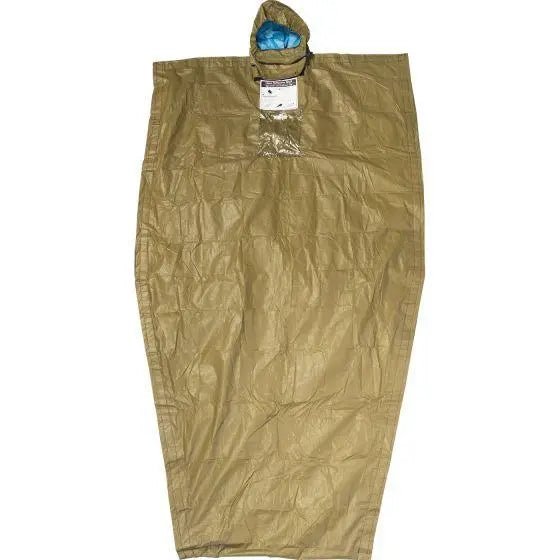
The HRS™ is the outer shell component of the HPMK® (Hypothermia Prevention and Management Kit), which is CoTCCC-recommended for prevention of hypothermia during casualty care. The HRS standalone product provides the same patented thermal covering capability as the HPMK outer shell — it is the same reinforced 4-ply composite fabric with non-conductive reflective layer. When used with a compatible self-heating liner or chemical warming source, it meets the HPMK system's thermal protection performance.
What is the purpose of the built-in hood on the HRS?
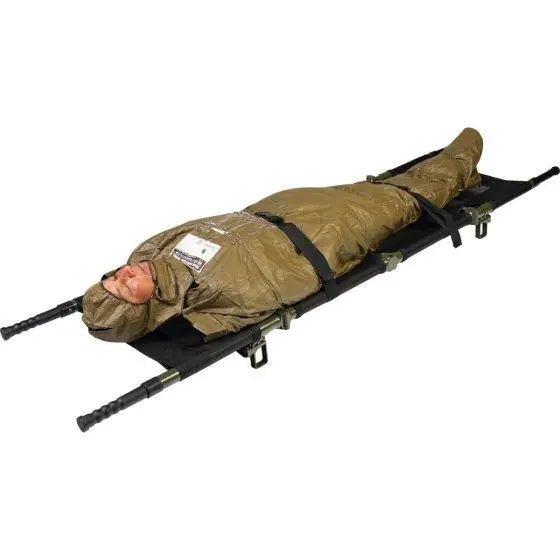
The hood covers the head and cervical region — an area responsible for a disproportionate amount of body heat loss in trauma patients. Standard emergency blankets cover only the torso, leaving the head and neck exposed to ambient temperature. The HRS's built-in hood extends the thermal envelope to include the entire body, including areas where blood vessels run close to the surface (carotid artery, scalp). In cold weather and prolonged field care scenarios, this hood coverage meaningfully reduces total heat loss.
How does the 360° Velcro closure system improve patient care?
The 1.5-inch continuous Velcro® closures running the full perimeter of the HRS allow providers to open and access any portion of the patient's body without removing the thermal covering entirely. This enables wound reassessment, tourniquet checks, IV adjustments, and airway interventions while keeping the rest of the patient insulated. Traditional emergency blankets must be removed entirely for any intervention, resulting in significant heat loss and re-exposure to the elements during each procedure.
Can the HRS be used without the self-heating liner from the HPMK?
Yes. The HRS can be used as a standalone thermal covering — even without the HPMK's self-heating liner, it provides meaningful passive thermal protection through its reflective layer and wind/rain resistance. It is significantly more durable and effective than standard Mylar space blankets. For maximum thermal performance in cold environments, it should be paired with a chemical warming source such as the HPMK liner or Ready Heat blanket. The HRS-I (Insulated) version adds a built-in insulation layer for environments requiring higher thermal retention without a separate liner.
What is the difference between the HRS and the HRS-I (Insulated)?
The standard HRS is a 4-ply composite fabric outer shell relying primarily on its reflective layer for thermal protection — best used with a separate self-heating liner (as in the HPMK). The HRS-I (Insulated) uses a 5-ply construction with an added Climashield insulation layer, providing higher intrinsic thermal retention without requiring a separate heat source. The HRS-I is part of the HPMK-I kit and is designed for environments where passive insulation alone must maintain patient temperature. In very cold environments, the HRS-I with its 4-cell Ready Heat blanket provides superior combined thermal performance.
Is the Heat Reflective Shell CoTCCC-recommended?
The HRS is the outer shell component of the HPMK® (Hypothermia Prevention and Management Kit), which is CoTCCC-recommended for hypothermia prevention during casualty care. As the same reinforced 4-ply composite shell used in the HPMK, the standalone HRS provides CoTCCC-aligned thermal protection when paired with an appropriate warming source.
Can the HRS be used without a self-heating liner?
Yes. The HRS provides meaningful passive thermal protection through its reflective layer and wind/rain resistance even without an active warming liner. It significantly outperforms Mylar space blankets as a passive covering. For maximum CoTCCC-compliant performance, pair the HRS with the HPMK self-heating liner or a Ready Heat chemical warming blanket.
How does the HRS support patient weight during transport?
The 1.5-inch continuous Velcro closures running the perimeter of the HRS are rated for 250+ lb loads. This allows the HRS to remain closed and supporting a packaged casualty during lifting, litter carries, helicopter loading, and vehicle transport — forces that would tear a standard emergency blanket.
What is the difference between the standard HRS and the HRS-Insulated (HRS-I)?
The standard HRS uses a reflective layer for thermal protection — best with an active warming liner in cold environments. The HRS-I (Insulated) adds a built-in Climashield synthetic insulation layer, providing higher passive thermal retention in extreme cold without requiring a separate liner. The HRS-I is appropriate for cold-weather operations where an active warming liner may not always be available.
Does the HRS allow wound reassessment without removing the covering?
Yes. The continuous Velcro closures allow providers to open any portion of the HRS for wound reassessment, tourniquet checks, IV line access, and airway interventions without removing the covering entirely. This maintains the patient's thermal envelope and avoids the heat loss associated with completely removing and reapplying a thermal covering.