


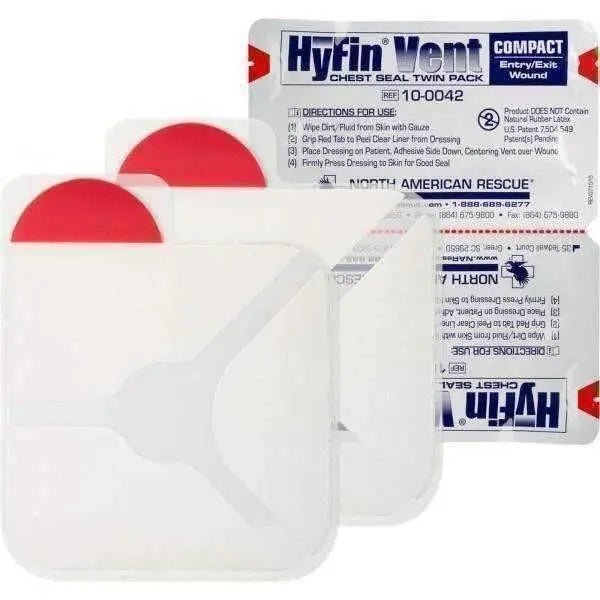


Tension pneumothorax is the second-leading cause of preventable death in trauma. An open chest wound lets atmospheric air into the pleural space with every breath, progressively collapsing the lung and choking off venous return within minutes. A seal that won't fit your kit — or won't vent — isn't there when it counts.
When a chest goes open and starts sucking air, is the seal in your kit vented, sealed, and sized to actually fit?
The HyFin Vent Compact closes that gap with the same proven 3-channel venting as the full-size HyFin Vent in a footprint about 25% smaller — small enough to carry two without folding the adhesive. Per the current TCCC Guidelines, open and sucking chest wounds are treated by immediately applying a vented chest seal; the twin pack lets you cover both the entry and the exit wound, the standard of care for penetrating thoracic trauma.
Built To Vent, Not Just Cover
3-Channel Pressure Relief
Vents accumulating pleural air on exhalation and seals against the skin on inhalation. If two channels clog with blood, the third keeps working.
Compact IFAK Fit
About 25% smaller than the standard HyFin Vent — two 4.75″ seals fit standard IFAK pouches without folding or creasing the adhesive.
Hydrogel Adhesive
Bonds to bloody, sweaty, or hairy skin where lesser adhesives peel off.
Twin Pack — Entry + Exit
Perforated packaging opens one seal at a time, keeping the second sterile for the exit wound.
Red-Tip Technology® Notch
A tactile, visual tear notch for one-handed, glove-on opening under stress.
CoTCCC-Recommended Type
A vented chest seal — the first-line choice for penetrating chest trauma in the current TCCC Guidelines.
In Each Twin Pack
Twin Pack Contents
- 2× HyFin® Vent Compact seals (individually packaged, perforated)
- 3-channel pressure-relief vent + hydrogel adhesive
- Red-Tip Technology® tear notch on each seal
Vented Beats Non-Vented
The current TCCC Guidelines put vented seals first for penetrating chest trauma for one reason: a non-vented seal occludes the wound but offers no escape path if tension pneumothorax develops. The 3-channel design removes that risk. Apply to both wounds, monitor for rising respiratory distress, and 'burp' the seal if tension recurs — skills worth rehearsing before you need them.
Who Carries It
Tactical & LE Medics — penetrating-trauma capability staged in the IFAK or plate-carrier pouch.
EMS & First Responders — first-line occlusion for open chest wounds before transport.
Prepared Civilians & EDC — a real answer for penetrating thoracic trauma, not a bandage.
Range & Hunt — compact chest-seal coverage where gunshot trauma is the realistic risk.
Round Out Chest Care
Pair occlusion with the rest of the thoracic answer:
The HyFin Vent Compact, Up Close


Two Seals. Both Wounds. One Pack.
Genuine North American Rescue, CoTCCC-recommended vented format. Shipped from a clinician-founded, veteran-led team.
Key Specifications
| Manufacturer | North American Rescue (NAR) |
| Item # / SKU | 10-0042 |
| NATO NSN | 6510-01-682-2091 |
| Type | Vented (3-channel pressure relief) |
| Seal Dimensions | 4.75″ × 4.75″ (excluding tab) |
| Weight | 1.55 oz (twin pack) |
| Quantity | 2 seals — individually packaged, perforated |
| Adhesive | Advanced hydrogel — bloody/sweaty/hairy skin |
| Guideline Status | CoTCCC-recommended vented chest seal (current TCCC Guidelines) |
| Price | $11.00 |
When to Choose the HyFin Vent Compact Twin Pack
What's in the Compact Twin Pack (SKU: 10-0042, NATO NSN: 6510-01-682-2091):
- 2× HyFin Vent Compact Chest Seal — 4.75 in. × 4.75 in., individually packaged
- Red-Tip Technology tear-notch foil pouch on each seal
- Perforated twin packaging — open one without disturbing the second
Same patented 3-channel vents and advanced adhesive as the standard HyFin Vent — ~25% smaller package. 1.55 oz total weight. Does not require folding to fit in cargo pocket or IFAK.
- Space-constrained IFAKs and ankle kits — the Compact fits pouches where the standard 6 × 6 HyFin physically won't; same 3-channel valve, smaller footprint at 4.75 × 4.75 in. and 1.55 oz.
- Law enforcement vest-integrated chest seal pouches — many LE carrier pocket inserts are sized for the Compact. No folding required to fit a cargo pocket or body armor pocket.
- Pediatric and small-frame patients — the smaller adhesive surface is appropriate for narrow chest walls where the standard 6-inch seal would overlap across wound sites or fold over ribs.
- Austere operations where weight and cube are critical — shaving 0.95 oz and ~25% volume per chest seal adds up on long-duration patrols where every gram is deliberate.
- Redundant / backup chest seal in standard IFAK — stage a standard HyFin Vent as primary, Compact as secondary; total kit volume remains manageable.
Same application protocol as the standard HyFin Vent. Identical 3-channel valve, identical adhesive formulation, identical peel-and-place technique. The only difference is form factor.
Selection guidance: If your kit has room for the standard, use the standard — more adhesive surface means more margin on irregular chest anatomy. Use the Compact only when the standard genuinely does not fit your pouch configuration.
HyFin Vent Compact vs. Alternatives
HyFin Vent Compact (10-0042) vs. Standard HyFin Vent (10-0037): Standard: 6 × 6 in. / 2.5 oz. Compact: 4.75 × 4.75 in. / 1.55 oz — approximately 25% smaller packaging. Clinically equivalent: same 3-channel valve, same adhesive, same application technique. Choose Compact only when kit space is genuinely the constraint — never as a cost trade-off (price difference is negligible).
HyFin Vent Compact vs. Halo Vent: Halo does not offer a compact variant. For size-constrained kits that require a vented CoTCCC chest seal, the HyFin Compact is the primary option. NATO NSN: 6510-01-682-2091.
HyFin Vent Compact vs. QuikClot Chest Seal: QuikClot chest seals use a different adhesive chemistry and are not on the current CoTCCC recommended list. For TCCC-compliant kitting, specify HyFin products.
Compact Twin Pack vs. USMC Combo Pack: Compact Twin = two smaller vented seals. USMC Combo = one standard vented + one standard occlusive. Different products for different protocols — not interchangeable. The USMC Combo does not currently have a compact variant.
Frequently Asked Questions
Q: Is the Compact clinically equivalent to the standard HyFin Vent?
A: Yes for most adult patients. Same patented 3-channel valve and advanced adhesive formulation. The smaller adhesive ring (4.75 in. vs. 6 in.) provides slightly less surface area around wound margins — for standard adult penetrating chest wounds, the Compact performs equivalently in clinical and training scenarios.
Q: What are the exact dimensions?
A: Compact: deployed seal 4.75 × 4.75 in., packaged 3.875 in. × 6.6 in. × 0.13 in., weight 1.55 oz. Standard HyFin Vent: deployed seal 6 × 6 in., packaged 7.5 in. × 4.5 in. × 0.25 in. (folded) or 7.5 in. × 9 in. (unfolded), weight 2.5 oz. The Compact does not need to be folded to fit a standard cargo pocket.
Q: Does the Compact valve work the same way as the standard?
A: Yes. Both use NAR's patented 3-channel pressure relief vent design — same valve mechanism, same exhalation venting, same inhalation occlusion. Only the surrounding adhesive ring is smaller.
Q: Can I use the Compact on a pediatric patient?
A: Yes — the smaller footprint is often more appropriate for pediatric chest anatomy. For pediatric TCCC scenarios, the Compact is the preferred HyFin variant. Ensure the adhesive ring fully covers wound margins on all sides with some overlap.
Q: What is the NATO NSN for government procurement?
A: NATO NSN: 6510-01-682-2091. MED-TAC is SDVOSB-certified and can process government purchase orders. Contact orders@tactical-medicine.com for procurement documentation and volume pricing.
Related searches: HyFin Vent Compact Chest Seal, vented chest seal twin pack, NAR 10-0042, CoTCCC chest seal, sucking chest wound seal, tension pneumothorax, occlusive dressing, IFAK chest seal, penetrating chest trauma
All products sourced from the actual brand manufacturer or authorized master distributors. CoTCCC recommendation status verified where applicable. Ships from MED-TAC International, Pembroke Pines, FL — clinician-founded, veteran-led, SDVOSB-certified.
Specifications coming soon. Contact us for detailed product information.
FREQUENTLY ASKED QUESTIONS
Customer Reviews


